





The Far Right Triumphs in Chile
Far-right ideologue José Antonio Kast. Photo: José Antonio Kast / X
There was little doubt about the outcome of Chile’s second round presidential election on December 14. After receiving overwhelming support from almost the entire Chilean right (which, if you add up their vote shares in the first round, represented the vast majority), José Antonio Kast will become Chile’s next president.
In the first round, Jeanette Jara narrowly took first place with 26.85%, followed closely by Kast, who won 23.93% of the valid votes, thus securing his place in the runoff. In third, fourth, and fifth place were three right-wing candidates: center-right Franco Parisi (19.71%), libertarian Johannes Kaiser (13.94%), and conservative Evelyn Matthei (12.47%). All of them asked their voters to support Kast in the second round and joined his campaign.
Thus, on his third attempt, the far-right candidate, who ran for the Cambio por Chile coalition, won 58.2% of the valid votes, far ahead of Jeanette Jara, from the Unidad por Chile coalition, who won 41.8% after 99% of the ballots were counted. Thus, although the Chilean Communist Party activist managed to garner considerable support, she was unable to reverse a right-wing trend that mobilized the majority of the electorate.
In a message on X, Jara acknowledged her defeat: “Democracy has spoken loud and clear. I have just spoken with President-elect José Antonio Kast to wish him success for the good of Chile. To those who supported us and were called upon by our candidacy, rest assured that we will continue working to advance a better life in our homeland. Together and standing tall, as we have always done.”
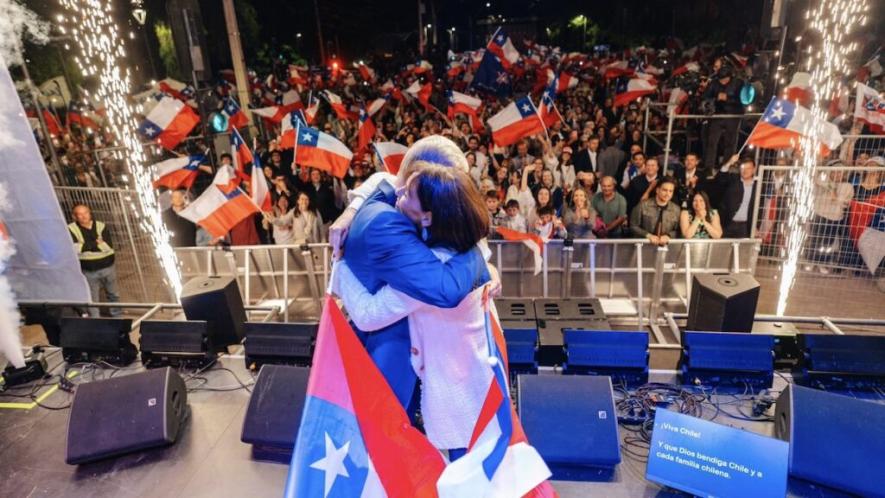
For his part, Kast celebrated his victory: “This is a day of joy… Millions of Chileans decided to rise up, to stand up. This is not a personal victory or a victory for one party. Chile has won, and so has the hope of living without fear… We are going to restore the law and respect for the law in all regions without exception, without political, administrative, or judicial privileges… We celebrate the advance of freedom.”
The defeat of the Chilean center-left
Jara represented the continuity of Gabriel Boric’s center-left government, which has not enjoyed overwhelming popularity during his term in office. However, it is important to emphasize that the tendency not to re-elect a political project seems to be almost a historical law. Since the return to democracy, no ruling party or coalition has managed to win re-election, so the Chilean electorate seems to be a kind of ideological pendulum that demonstrates, in reality, the inability of its governments to convince people to immediately trust their plan again. Nevertheless, it is also a country where former presidents such as Michelle Bachelet (2006-2010 and 2014-2018) and Sebastián Piñera (2010-2014 and 2018-2022) returned to the La Moneda presidential palace, although never consecutively.
However, it is the first time since the return to democracy that a far-right candidate that has openly identified with Pinochet has won. After the bloody Pinochet dictatorship (1973-1990), in which more than 3,000 people were killed, and there were more than 38,000 victims of human rights violations, it was politically inconvenient to be associated with the far right and Pinochet, though that did not stop many from admiring him.
The shift to the far right in Chile
One of them is the future president of Chile. 59-year-old Kast ran for president in 2017 and 2022 and had always faced strong resistance from the majority of the Chilean electorate due to his far-right statements in favor of the dictatorship and his proposal to ban abortion in the South American country. Kast’s German-born father was a member of the German Nazi Party.
Several years ago, he said that if Pinochet were alive, he would vote for him, which did not go down well in a country still trying to heal social trauma. In these elections, Kast decided to take a less controversial stance and pledged to take into account the political programs of the other right-wing candidates.
Kast won over many people with his populist, alarmist campaign and by building his image as a kind of savior who will rescue Chile. Under the slogan “Chile is falling apart,” Kast promised to launch an “emergency government” to tackle what he calls “the worst crisis in Chile’s history.” Chile’s president-elect has decided to blame countless problems on migrants from neighboring countries who seek work in the South American country.
Kast said he will fortify the border with fences and ditches to stop them from entering. What’s more, during his campaign, he started a countdown to the day when the more than 380,000 undocumented migrants working in Chile will leave the country voluntarily. If they do not, the far-right politician has promised to find them and expel them.
On economic issues, Kast, a self-declared admirer of Argentine President Javier Milei, promises radical neoliberal reform: cutting fiscal spending by more than USD 6 billion in just 18 months without allegedly affecting social spending, which has been seen by several Chilean economists as impossible unless he cuts the budget for social programs.
On the diplomatic front, Kast has expressed his strong support for President Donald Trump, which several analysts have interpreted as a realignment of Santiago’s international policy in line with Washington. And while Boric had not been particularly critical of Washington, he did maintain a very critical stance on the Palestinian genocide and was in favor of greater regional integration. Kast will surely abandon those diplomatic positions in order to cozy up to Washington.
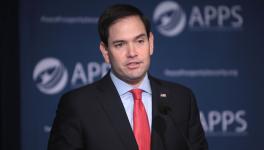
US Secretary of State Marco Rubio wrote: “Congratulations to Chile’s president-elect José Antonio Kast on his victory. The United States looks forward to working with his administration to strengthen regional security and revitalize our trade relationship.”
Thus, in less than two months, two countries, Bolivia (Rodrigo Paz) and Chile (José Antonio Kast), have shifted to the right and joined several South American countries that are governed by countries close to Washington, such as Ecuador, Peru, Paraguay, and Argentina. On the other hand, Brazil, Colombia, Uruguay, and Venezuela still maintain center-left and left-wing political projects that resist what some analysts have called “the shift to the right in South America.”
Courtesy: Peoples Dispatch
Get the latest reports & analysis with people's perspective on Protests, movements & deep analytical videos, discussions of the current affairs in your Telegram app. Subscribe to NewsClick's Telegram channel & get Real-Time updates on stories, as they get published on our website.