





Shield of Americas: Trump’s New Tool for Hemispheric Military Coordination
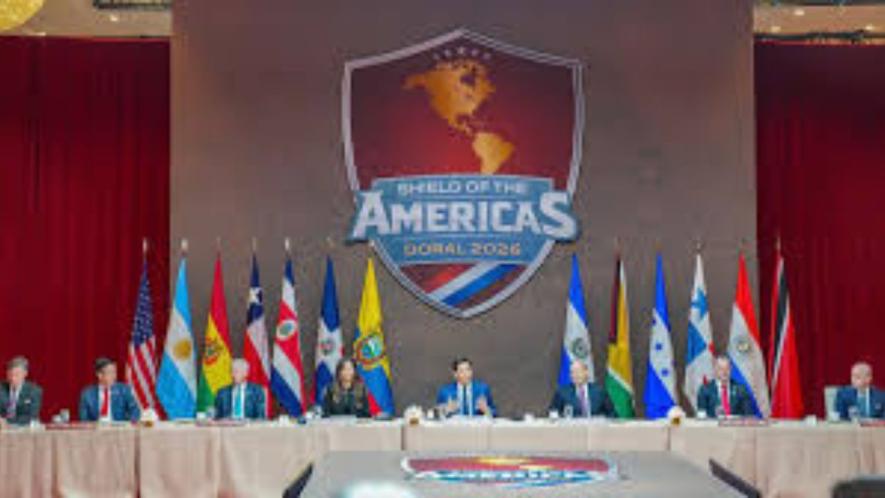
US Secretary of State Marco Rubio addresses Shield of the Americas Summit. Photo: Dept of State
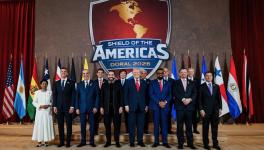
This past weekend, the Trump administration secured an alliance with its partners in Latin America and the Caribbean. The so-called “Shield of the Americas” is an alliance between 13 countries in the Americas to undertake intelligence, security, and even military actions aimed at preserving US hegemony, which could be threatened by other world powers. The creation of the alliance was agreed upon during the “Shield of the Americas” Summit held this past weekend in Doral, Florida.
Regarding the alliance, the US State Department declared: “This historic coalition of nations will work together to advance strategies that stop foreign interference in our hemisphere, criminal and narco-terrorist gangs and cartels, and illegal and mass immigration.”
What does the agreement propose?
The agreement, signed by the attending presidents at the conclusion of the Summit, ensures that all available mechanisms will be used to confront “serious dangers” in conjunction with allied nations. “These international entities control territories and trade, extort political and judicial systems, wield weapons and deploy military capabilities, and use murder and terrorism to achieve their ends,” Trump said before a row of Latin American presidents who applauded whenever they could.
Trump also proclaimed: “Criminal cartels and foreign terrorist organizations in the Western Hemisphere must be demolished to the greatest extent possible, in accordance with applicable law … The only way to defeat these enemies is by unleashing the power of our armies. We have to use our military. You have to use your military.”
But perhaps most striking is that Washington stated that it will train and mobilize the forces of partner nations to make it easier to achieve the stated objectives, which makes it clear who will lead the Shield of the Americas (if there was any doubt). Thus, to give one example, it is now known for certain who is directing the operations in Ecuadorian territory, which were announced by Quito and Washington in recent days.
Kristi Noem, who until recently served as secretary of Homeland Security, is responsible for coordinating the Shield of the Americas. On X, Noem expressed her gratitude for Trump’s decision to put her in charge of the new agency that seeks to ensure Washington’s hemispheric preeminence: “Thank you, Trump, for appointing me as the Special Envoy for the Shield of the Americas. Secretary Marc Rubio and Secretary Pete Hegseth are incredible leaders, and I look forward to working with them closely to dismantle cartels that have poured drugs into our nation and killed our children and grandchildren.”
Noem also affirmed: “The Western Hemisphere is absolutely critical for US security. In this new role, I will be able to build on the partnerships and national security expertise I forged over the last 13 months as Secretary of Homeland Security. We have made historic accomplishments at the Department of Homeland Security to make America safe again.”
A very useful agreement
The usefulness of a continental military alliance for the United States goes far beyond the attacks against drug cartels. Since September 2026, the United States has been conducting military operations in the Caribbean Sea, destroying dozens of small boats and killing dozens of their occupants. As of February 2026, over 40 strikes had been carried out as part of “Operation Southern Spear” and over 145 people had been killed.
On January 3, the United States launched a military assault against Venezuela, took President Nicolás Maduro and his wife, Cilia Flores, prisoner, and extradited them to New York. The death toll of the operation exceeded 100, including many civilians. Today, Washington has tacit control over Venezuelan oil, which is increasing in value amid the conflict in West Asia.
In addition, Trump has stated on several occasions that “soon the Cuban government will fall,” something he reiterated last weekend in front of Latin American presidents who did not hesitate to applaud. A few days ago, the Noboa government broke diplomatic relations with Cuba and expelled its entire delegation, which illustrates one of the functions that coordinated action directed by the United States could have.
In other words, with this agreement, Trump not only ensures control and direction of future military operations in the Americas but also places those forces at the disposal of his global geopolitical project, which could have unforeseen results in a future world scenario that is currently undetermined.
Being Trump’s ally: political capital and security
Despite the announcement of a regional alliance, the summit was not attended by representatives from large countries that have been fighting drug trafficking for several decades, such as Mexico, Colombia, Venezuela, and Brazil, among others, whose presidents ultimately identify as left-wing or progressive.
Those who did attend are the leaders of governments that have aligned themselves almost entirely behind Washington’s geopolitical interests during the Trump administration, and who are mostly right-wing or far-right: Javier Milei of Argentina, Rodrigo Paz of Bolivia, Rodrigo Chaves of Costa Rica, Luis Abinader of the Dominican Republic, Nayib Bukele of El Salvador, Irfaan Ali of Guyana, Daniel Noboa of Ecuador, Nasry Asfura of Honduras, José Raúl Mulino of Panama, Santiago Peña of Paraguay, Kamla Persad-Bissessar of Trinidad and Tobago; and the president-elect of Chile, José Antonio Kast, who will take office on March 11.
Despite criticism from opposition groups in these countries, who see the signing of the Shield of the Americas agreement as a shameful subjugation to Washington’s interests (even against the economic interests of the countries they represent), the presidents who attended the meeting in Miami defended the signing of the alliance.
This was expressed by the Ecuadorian president, who wrote on his Twitter account: “For too long, the mafias believed that America was their territory. That they could cross borders, move drugs, weapons, and violence without consequences. That time is over.”
A few hours before the event, Chile’s president-elect said: “Taking off for the United States to meet with President Donald Trump and several Latin American leaders. We will discuss security, illegal immigration, and economic progress for our nations. We continue working to improve Chile’s future.”
For his part, Nayib Bukele, president of El Salvador, reposted the same video at least five times, showing Trump and him chatting amiably during the photo session the US president had with each of the attendees.
Thus, the continent’s right-wing presidents have found in Trump’s image a kind of messianic figure behind whom they feel a sense of regional unity that differs from that sought by progressive governments, which have for the last two decades attempted to build spaces free of US involvement such as UNASUR, ALBA-TCP, and CELAC.
In this way, Trump and his geopolitics stand as a course that Latin American right-wing governments must follow unflinchingly. Journalist Ayelén Oliva said: “The image of Trump sitting behind his desk surrounded by standing Latin American leaders symbolizes these countries’ alignment with the United States, whom Secretary of State Marco Rubio called ‘friends.’”
Courtesy: Peoples Dispatch
Get the latest reports & analysis with people's perspective on Protests, movements & deep analytical videos, discussions of the current affairs in your Telegram app. Subscribe to NewsClick's Telegram channel & get Real-Time updates on stories, as they get published on our website.