






Dhurandhar: A Fantasy That Mistakes Failure for Fortitude
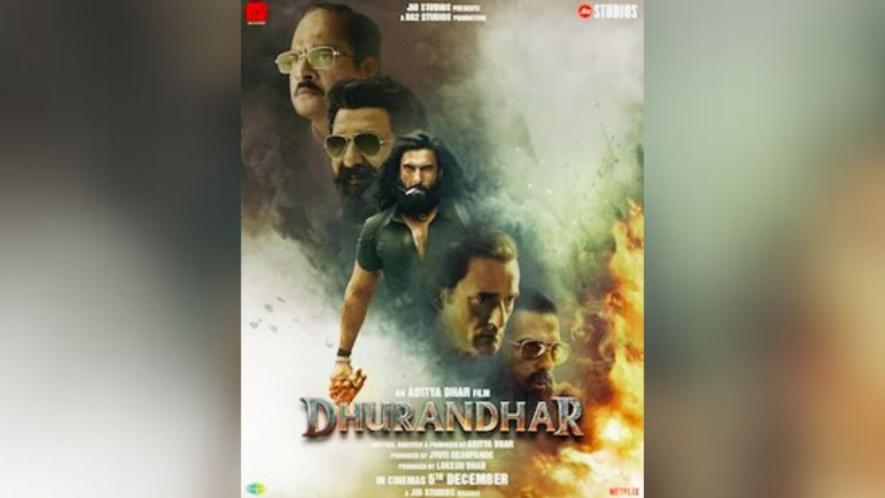
Image Courtesy: Wikipedia
The release of Hindi film Dhurandhar on Netflix made it morally inexcusable to avoid the film—for anyone who grew up on Bollywood masala and its traditionally performative swagger, agenda or not. And yet, of late, the fear of disappointment after entering a theatre overrides the old addiction. Perhaps the Covid break was the cold-turkey period, when one discovered the adequacy of home viewing: the luxury of dozing off without FOMO (fear of missing out). I did exactly that—within 15 minutes—and the reasons became clearer as the film staggered along.
By the time we were well into adulthood, we had already seen what serious underworld world-building looked like. Mani Ratnam’s Tamil film Nayakan crafted a sinister world not through noise but through extraction—of menace, silence, moral ambiguity—clearly inspired by Hollywood’s The Godfather, yet indigenised with cinematic intelligence. That film permanently altered the DNA of commercial cinema, song and all. The crossover between parallel cinema and the mainstream became fluid, technicians travelled freely, and underplay became an idiom rather than a risk.
In the pre-digital era, this grammar was amplified by Hindi films Agneepath, Ardha Satya, Parinda, and eventually Satya. Taken together, these films did something Dhurandhar also attempts but fails to sustain: they located violence not only in criminals but in systems—police, politics, masculinity, and complicity itself—without mistaking rage for power or noise for resolution. The underworld ceased to be a gilded lion’s den and became claustrophobic, human, morally compromised. Anti-heroes were humanised not to make them admirable, but to make them frighteningly believable.
As the 1990s unfolded and the Mumbai underworld acquired a communal colouring—abetted by the Pakistani deep state—cinema responded accordingly. Dons were no longer just criminals; they were traitors, terrorists, forces corroding the societies they operated in. Dawood (Ibrahim) crossed the Rubicon. So did the cinema.
This is where Dhurandhar stumbles first, and fatally. The Pakistani underworld of Lyari is shown as bloodthirsty, yes, but also improbably patriotic—aligned exclusively to the project of hurting India, not to any internal Pakistani reality. Their violence carries no domestic cost, no social consequence. Meanwhile, the film curiously casts Baloch nationalists—toward whom India has some sympathy—as villains to India’s cause. With an aspirational swagger.
The film braids real history with fiction—fair game. But the entry and exit points between the two lack any internal logic. IC-814 is kept intact. Indian negotiators bear unmistakable resemblance to real figures, yet are given fictional names. Former Pakistan Prime Minister Benazir Bhutto remains Benazir, while President Asif Ali Zardari becomes “Zarwari.” Why this selective coyness? What exactly is being protected here—history, liability, or convenience?
The most damning failure lies in the handling of the protagonist as a super-intelligence asset. He procures a weapon from Baloch tribals and hands it over to Ajmal Kasab. He later identifies Kasab on television during the 26/11 Mumbai terror attack broadcast. This is not tragic irony; it is narrative abdication. An asset who facilitates catastrophe and survives without consequence is not morally conflicted—he is narratively incoherent. If this is meant to illustrate the fog of intelligence work, it does so by making incompetence indistinguishable from heroism.
So, what nationalistic victory does Dhurandhar actually claim? Irrespective of which government is in power, India is shown as a perpetual loser—penetrated networks, absorbing blows, but never altering outcomes. There is no retribution, no strategic inflection, no sense of a price being paid by the adversarial system. The film’s cheerleaders arrive pre-convinced, cheering “wins” in the same way audiences once cheered a lanky Amitabh Bachchan flattening a field of hefty ruffians. That was a conscious suspension of disbelief; everyone understood the contract. What we have now is something worse: a narrative pre-conviction that reframes failure as fortitude, loss as moral victory, and serendipitous survival as bravery.
The attempt to lay blame at the doors of earlier governments is especially ludicrous given the continuity of India’s security spine. The institutional core remains the same; only the rhetoric changes. The talk of a “grand design” collapses under the weight of what the film itself shows—reaction without consequence, intelligence without agency, noise without power.
Meanwhile, the outrage over Dhurandhar in Pakistan appears largely performative, confined to the establishment rather than the public. That silence does not signal maturity or redemption; it merely suggests indifference to spectacle. What is unmistakable is the farce on this side: an Indian filmmaker scoring a clear self-goal while the home crowd celebrates it like a World Cup victory. Faith in performance over consequence is not conviction—it is foolishness, regardless of which side of the political divide one claims to occupy.
Read Also: Soft Power Isn’t Spectacular Jingoism: Why Loud Cinema Gets it Wrong
Ironically, two Kabir Khan films from the previous decade achieved far more meaningful soft-power outcomes. Phantom, however fantastical, at least attempted closure by eliminating a key conspirator of 26/11, if only imaginatively. Bajrangi Bhaijaan did something more radical: it reclaimed Bajrangbali not as a symbol of virulence and fear, but as an embodiment of compassion, restraint, and dharma. That, too, is nationalism—one that does not require repeated failure to feel righteous.
Technically, Dhurandhar is slick. But slickness is cheap now. In an age of AI and digital imagery, YouTubers routinely achieve polish that bona fide filmmakers could not a decade ago. As someone with over three decades in full-spectrum television, I found the choreography of combat, the camera angles, and the dialogue staging uncomfortably reminiscent of news-television reconstructions—hurried recreations that flatten reality while pretending to dramatise it. Except here, there is no excuse of budget or immediacy.
Akshaye Khanna is superb, his sequence with the Baloch trtibals should have been introductory, and Rakesh Bedi rises above the clutter. But the Pakistani flavour is disastrously inauthentic. Anyone familiar with the cadence of Pakistani Hindi, Urdu, or Punjabi will feel the falseness immediately. Language is world-building; accents do more work than costumes, get ups and sets. From Baji Rao to Khilji and now this, Ranveer Singh’s familiar one-routine-fits-all approach doesn’t help
In the end, Dhurandhar collapses in intent. It is neither retributive for India nor redemptive for Pakistanis. But at that length with so little to say, it exhausts. And exhaustion, in cinema, is the deadliest sin of all.
If India aspires to have the kind of soft power Hollywood wielded during the Cold War—even through its pulp—we do not need raging minds imagining on-the-nose redemptions. We need stories and actions adjacent to actual victories of the past 80 years, not freshly minted narratives signalling new figureheads on the currency.
The writer is an independent journalist. The views are personal.
Get the latest reports & analysis with people's perspective on Protests, movements & deep analytical videos, discussions of the current affairs in your Telegram app. Subscribe to NewsClick's Telegram channel & get Real-Time updates on stories, as they get published on our website.