





West Bengal: Growing Distress of Potato Farmers
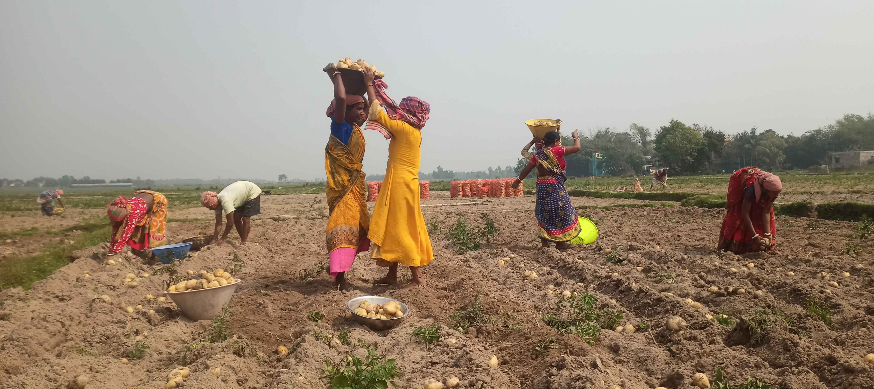
Farmers harvesting potatoes and piling them up in the fields. This image was taken in the field of Raibaghini village in Kululpur Block of Bankura . Photo by Madhu Sudan Chatterjee
Across rural Bengal, a deep sense of uncertainty has begun to take hold among potato farmers this season. What is usually a time of relief after months of labour has instead turned into a period marked by anxiety, financial strain, and difficult questions about survival.
Due to a continuous drop in market prices of potatoes following the harvest, farmers across several districts are struggling to find buyers for their produce. Those who invested heavily in potato cultivation are now living in a state of extreme uncertainty. A majority of these farmers had taken loans to fund their cultivation. With the market collapsing, they are now haunted by the question of how to repay their debts while sustaining their families.
In the midst of this deepening crisis, a disturbing rise in deaths among potato farmers has cast a dark shadow across the state. Over 15 days, four farmers in Bengal have reportedly died due to distress in the agrarian sector. On March 11, a marginal farmer Rakhal Ari, 28, from Rangamati village in Chadrakona 1 block of Paschim Medinipur district died by suicide after consuming pesticide at his home. Earlier, a farmer named Sahadeb Pal, 54, from Amrapath village in Goghat 2 block under Hooghly district also reportedly took his own life. In a similar tragedy, an elderly farmer, Shailen Ghose, 78, from Kadipara village in Kalna 2 block under Purbo Bardhaman died by hanging himself. On Monday, March 23, morning, 35-year-old sharecropper Haripada Bag of Jharul village in Chandrakona 1 block under Paschim Medinipur district collapsed and died in his fields. He was reportedly unable to bear the sight of the potatoes he had cultivated rotting in the fields.
It can be said that lakhs of potato farmers across West Bengal now stand on the brink of ruin, staring into a precipice of complete devastation. Who will save them? This haunting question now echoes across every corner of the state.
The price of potatoes is falling rapidly every day. On March 24, the price of the most popular Jyoti variety of potatoes was Rs 600 per quintal, yet there were no buyers. Nearly 40% of this year’s potato production is still lying in the fields, with no buyers in sight. What will happen to unsold produce continues to haunt thousands of farmers.
The scale of distress facing potato farmers in West Bengal came into sharp focus on Tuesday, as a voice from one of state’s key potato-growing belts painted a grim picture. In Raibaghini village under Kotulpur block of Bankura district, farmer Jayanta Mallik laid bare the harsh economics crushing cultivators.
“A tractor load of potatoes, about 50 quintals, fetches barely Rs 5,000 in the market,” he told this writer, adding “transporting that same load to a cold storage facility costs another Rs 5,000 in tractor rent alone”. The burden does not end there. Farmers spend Rs 30 per sack to pack 50 kilograms of potatoes, while storage charges at cold facilities stand at Rs 184 per quintal. With input coasts far outstripping returns, cultivators say they are being pushed to the brink.
“Just think about where we have reached”, Mallik said, his voice heavy with despair. “Soon, we may have to step out with begging bowls,” he added.
Govt Measures and Gaps on Ground
The situation has raised serious concern among potato farmers across the state. In response to falling prices, the State Agriculture Marketing Department issued a directive on February 13 stating that the government would procure potatoes from farmers holding Krishak Bandhu cards at a rate of ₹950 per quintal. Each farmer would be allowed to sell up to 35 quintals (70 packets) of potatoes to the government.
According to the directive, the procured potatoes would be stored under the supervision of the respective District Magistrates. Cold storage facilities were also instructed to keep 30% of their capacity vacant until March 25 to accommodate government procurement.
However, despite the announcement, government procurement has reportedly taken place in only one or two areas in the state. In most areas, farmers say that no potatoes have been purchased so far. As a result, they are being forced to store their produce in cold storages at a heavy loss. Most storage facilities are already filled to capacity, leaving farmers with few options.
A Wider Structural Crisis
Uttar Pradesh is the largest producer of potatoes in India, followed by West Bengal. The state has vast tracts of suitable soil and favourable weather conditions for potato cultivation. Every year, between the first and last week of November, different varieties of potato seeds are planted across West Bengal.
The leading potato-producing districts include Hooghly, Purba and Paschim Bardhaman, Paschim Medinipur and Bankura. Other significant potato-growing districts are Howrah, Jhargram, Birbhum, Murshidabad, Jalpaiguri, Alipurduar, Uttar Dinajpur and Nadia.
Several varieties of potatoes are cultivated in Bengal, including Jyoti, Pokhraj, Himanggini, S-6, Chandramukhi and K-22. Among these, Jyoti is the most widely cultivated and has the highest market demand.
According to reliable sources in the Agriculture Department, this year potatoes have been cultivated on 5.14 lakh hectares. The state government estimates that total potato production, including all varieties, will reach 140–150 lakh tonnes. This is a 20% rise over last year and marks a new record for potato production in the state.
Nearly 10 lakh families in the state are involved in potato cultivation. The 496 cold storage facilities have a total capacity of 82 lakh tonnes. Farmers are unable to figure out how prices will improve for potatoes that cannot be stored in cold storage. At most, 16 crore 40 lakh packets of potatoes (each weighing 50 kg) can be stored, whereas total production this year has reached nearly 26 crore packets.
“Where will the remaining potatoes go?” questioned Lalu Mukherjee, state secretary of Paschimbanga Pragatisheel Alu Byabsayi Samity.
Voices from Different Districts
“No one is quoting a fair price for potatoes. The rates are falling every day. It’s impossible to store all the produce in cold storages, so we are leaving the harvested potatoes in the fields, covered with straw, hoping prices will improve. But due to lack of buyers, these potatoes are now rotting,” said Tapan Maity from Parshura in Hooghly district.
He said Chandramukhi potatoes are priced at around ₹600 per quintal, Jyoti at ₹100, while Pokhraj, Hemalini and Colombo varieties are not finding buyers even at ₹50 per quintal.
Farmers Jayanta Mallik and SubashKundu from Raibaghini village of Kotulpur in Bankura district echoed similar distress. Large quantities of potatoes remain unsold in the fields. They further pointed out that even the cost of synthetic bags has surged, with a 50 kg sack now costing ₹25-30.
“If we earn barely ₹30 from selling a sack of potatoes (50kg) and have to spend ₹25 just to buy the bag, what are we left with?” they said, adding “We are being pushed into complete ruin.”
Regarding the state government’s directive asking cold storage owners to procure potatoes directly from farmers, several owners from Bankura, Medinipur and Hooghly districts expressed concern that they would need to take loans from banks to do so.
“In that case, the government must act as the guarantor for those loans. Otherwise, if prices fall further, how will we repay the debt?” they questioned.
Despite these challenges, some cold storages in Hooghly and Medinipur have already begun purchasing potatoes. However, in districts like Bankura, the process is yet to start.
Limits of Relief Measures
The reality is that the government will not procure potatoes from all farmers. Purchases will be limited only to those who possess a Krishak Bandhu card. Moreover, there is a cap—only up to 35 quintals of potatoes will be bought from each farmer.
On average, potato yields this season have reached 50–60 quintals per bigha. With such production levels, farmers are left wondering where they will sell the remaining surplus.
A significant number of farmers do not have Krishak Bandhu cards, as many of them are sharecroppers. What will happen to them?
Adding to their distress, the government directive states that potatoes weighing less than 35 grams will not be procured. This raises yet another pressing question—what will become of the smaller-grade produce?
With no visible relief or clear solution in sight, the crisis facing Bengal’s potato farmers is deepening with each passing moment.
Life in Rangamati Village
Rangamati village, about 60 km north of Medinipur and around 10 km from Chandrakona town, is predominantly inhabited by Scheduled Caste (SC) communities largely dependent on agriculture for livelihood. There are no big landowners in the village.
“Most families in this village received pattas (permanent land titles) for government land during the Left Front regime. Earlier, we had to travel outside in search of work. After receiving the land titles, many agricultural labourers gradually became cultivators,” said Sanjay Bhuiya, a marginal farmer from Rangamati village. He said most villagers own no more than 4–5 bighas of cultivation land.
Another major problem in the area is that during the monsoon, floodwaters from the Shilaboti River often damage crops. Every year, paddy cultivation suffers significant losses due to flooding, and this year too farmers’ paddy crops were damaged.
“Last year, too, farmers did not receive a fair price for potatoes, although the losses were slightly lower. This year, however, the situation has been unfavourable right from the beginning. Potato production has been exceptionally high, reaching levels never seen before. Yet the pressing question is: where are the buyers?” said Tapan Pandit, a farmer from Rangamati village.
Scenes from the Fields
A visit to the village fields reveals a grim but quiet reality. Farmers, with downcast faces, continue harvesting potatoes under a cloud of uncertainty.
Batul Gurat, along with his wife Ila Gurat and their sons Anupam and Subham and daughter Tiya, were seen digging out potatoes from their land. In the adjoining field, TarapadaDalui, Animesh Badui, Kamala and Chhabi Ari were engaged in the same backbreaking task.
“We have spent nearly ₹30,000 per bigha to cultivate potatoes. Now the market sell price has fallen to ₹200 per quintal. We are staring at massive losses,” they said.
“Who will buy our produce? All of us are heading towards ruin. Who will save us?”
They added that leaving potatoes underground would only lead to further spoilage, forcing them to harvest despite losses.
“We cannot even afford to hire farm labourers. How will we get the money to pay their wages? We do not know what the future holds for us,” they said.
A Family’s Struggle
In Majhpara of the village stands the home of a marginal farmer whose family now sits silently on the veranda, overcome with grief and uncertainty. He was the sole earning member of the family. Left behind are his elderly mother, his wife, and two minor children.
“We have only 10 kathas of our own land. He had taken about three and a half bighas of land on share to cultivate potatoes. Now everything is ruined,” said his mother, Archana Ari, breaking down.
She recalled how she had struggled to raise her children after her husband passed away when her son was still in her womb. Over time, he became the sole support of the family.
His wife, Rita Ari, sat silently beside their two sons—Ananda, a Class VI student, and Abir, a Class II student.
“Before cultivating potatoes this year, my husband had pawned some of my jewellery to borrow money at interest. He also had outstanding debts at fertiliser and seed shops. For cultivation, he borrowed additional cash, promising that once the potatoes were harvested, he would repay all debts and redeem my jewellery,” she said.
She recalled how they harvested potatoes from their land together. A trader had promised to buy at ₹400 per quintal, but later reduced the price to ₹250.
“My husband was completely shattered,” she said, pointing to empty potato sacks lying unused.
“The cost of cultivation was nearly ₹30,000 per bigha. We produced around 60 quintals per bigha. If the price drops to ₹200 per quintal, we stand to incur a loss of nearly ₹20,000 per bigha,” she explained.
Administration and Response
In connection with the incident, Prasenjit Maity, the Krishi Karmadhyaksha of Chandrakona 1 Panchayat Samiti, stated that there are 48,753 farmers in the block who hold Krishak Bandhu cards.
“The government has announced procurement of potatoes from farmers; however, cold storage facilities are yet to begin purchasing. This has naturally led to a crisis situation. Moreover, with bumper production this season, prices have been falling steadily every day. We are unable to understand how to resolve this crisis at the moment. Farmers are suffering from deep distress,” he said.
Meanwhile, Block Development Officer Krishnendu Biswas stated that the administration is aware of the situation and has taken initiatives to procure potatoes.
Farmer organisations have also raised demands for higher procurement prices and compensation for affected families.
When Distress Turns into Tragedy
Amid this prolonged crisis, the strain on farmers has continued to intensify. Within a short span of time in March, three potato farmers in Bengal lost their lives.
Rakhal Ari (28) from Rangamati village in Paschim Medinipur, Sahadeb Nandi (57) from Hooghly district, and Sailen Ghose (78) from Kalna Block 2 were among those who died.
Their deaths have sent shockwaves across farming communities, deepening the sense of fear and uncertainty among others who are facing similar circumstances.
For many farmers across Bengal, the question remains unresolved—not just about prices or procurement, but about survival itself.
“A few years ago, potatoes from Bengal were exported to other states for sale. However, for the past three years, the state government has put a stop to this. As a result, the state has led to the crisis worsening to a severe level,” said Lalu Mukherjee, state secretary of Paschimbanga Pragatisheel Alu Byabsayi samity. He said neither farmers nor traders have any clear idea of how the potato situation will unfold this year. According to him, they are all standing on the brink of a potential disaster.
The writer covers the Jangalmahal region for ‘Ganashakti’ newspaper in West Bengal.
Get the latest reports & analysis with people's perspective on Protests, movements & deep analytical videos, discussions of the current affairs in your Telegram app. Subscribe to NewsClick's Telegram channel & get Real-Time updates on stories, as they get published on our website.