





As War in Sudan Continues Into 4th Year, Tensions Rise With Ethiopia
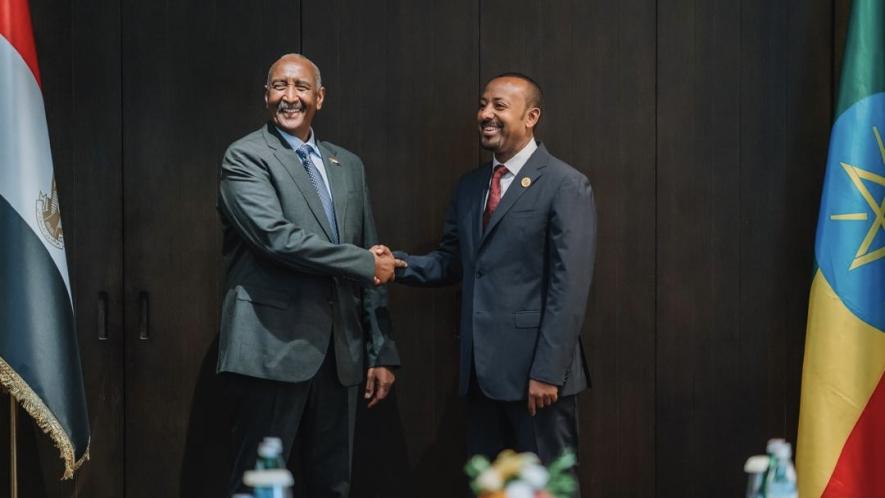
Ethiopian Prime Minister Abiy Ahmed and leader of the Sudanese Armed Forces General Abdel Fattah al-Burhan in September 2024. Photo: Abiy Ahmed / X
In the aftermath of the drone attack on the international airport in Khartoum, the capital of Sudan, ravaged by a civil war now continuing in its fourth year, the government recalled its ambassador from Ethiopia on May 5, accusing its neighbor of complicity.
The attack on May 4 came on the heels of the first international commercial flight landing at the airport since the civil war erupted in April 2023, when the paramilitary Rapid Support Forces (RSF) turned on its ruling partner, the Sudanese Armed Forces (SAF).
The airport had sustained heavy damage in the early days of the fighting. It was among the first locations the RSF attacked, before overrunning the SAF’s military bases and much of Khartoum.
The SAF-led government retreated from the capital and relocated to Port Sudan, which remained the seat of the administration for over two and a half years until January 2026, when the government announced its return to Khartoum. The SAF had recaptured the capital in May 2025.
After the administration rehabilitated the airport, a domestic commercial passenger flight landed at Khartoum airport on February 1, for the first time since the war began. This was followed by the landing of the first international flight on April 28, carrying 300 Sudanese citizens returning from Kuwait.
Less than a week later, on May 4, drones attacked the airport and military installations of the SAF in the Greater Khartoum region, destroying the semblance of peace and stability returning to Khartoum. In its twin city, Omdurman, a drone struck a civilian bus on May 2, killing five people.
Addressing the media on May 5, the SAF spokesperson Brigadier General Asim Abdelwahab said that the government has evidence showing that drones supplied by the UAE took off from Bahir Dar Airport in Ethiopia’s Amhara region in four different attacks since March 1. “What Ethiopia and the UAE have done is direct aggression against Sudan,” he insisted.
Ethiopia, a pawn in UAE’s “Port Imperialism”
Ethiopia has no strategic stake in the war in Sudan, maintains Mohammed Hassan, a historian and former Ethiopian diplomat. But the “UAE has bought over Prime Minister Abiy Ahmed. It is using him as a pawn” in what he describes as the Emirates’ “Port Imperialism”, seeking Africa’s Red Sea and Indian Ocean coastline, with particular interest in a port on Sudan’s Red Sea coast.
This strategic objective, among other considerations, informs its backing of the RSF, which, according to a UN fact-finding mission, committed “genocidal” atrocities late last year after overrunning El Fasher, which was the last major SAF holdout in Sudan’s western region of Darfur.
Further west, there have already been confrontations across Sudan’s border with Chad, a country also widely reported to be a conduit in the UAE’s supply chain for the RSF.
Now the war in Sudan also threatens to spill over its southeastern border, with Sudan’s Foreign Minister Mohieddin Salem announcing the country’s readiness to “enter into an open confrontation” with Ethiopia “if it becomes necessary.”
While Ethiopia’s foreign ministry has dismissed Sudan’s accusation as “baseless”, multiple media investigations, as well as a recent satellite imagery analysis by the US-based Yale University’s Humanitarian Research Lab, have shown evidence of Ethiopia’s support for the RSF.
Ethiopia has, in turn, accused Sudan of supporting armed groups in Ethiopia. However, PM Abiy Ahmed’s government itself has a history of shifting alliances between a plethora of ethnically organized armed groups, pitting one against another in an attempt to balance state power.
But Ahmed has lost this dangerous game he played, reducing himself to what some have called him “the mayor of Addis Ababa”, unable to step out of the capital, where armed groups reign over most of the remaining territory. Losing control domestically, Ahmed has made himself useful to the UAE, offering Ethiopian territory for the distant Gulf power to supply the RSF in neighbouring Sudan, Hassan maintains.
Courtesy: Peoples Dispatch
Get the latest reports & analysis with people's perspective on Protests, movements & deep analytical videos, discussions of the current affairs in your Telegram app. Subscribe to NewsClick's Telegram channel & get Real-Time updates on stories, as they get published on our website.