





US Bullying Reaches Indian Ocean
Credit: Special Arrangement
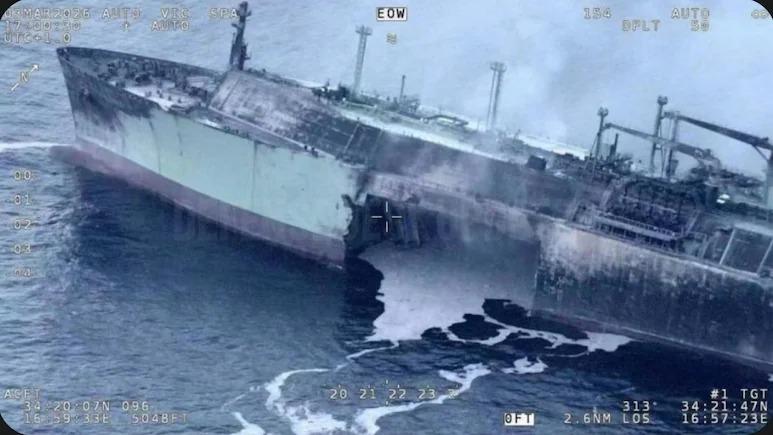
To demonstrate its unilateral action and global reach, the United States sank the Iranian warship IRIS Dena in the Indian Ocean on March 4, 2026, using a US Navy submarine. The attack was carried out with a torpedo, and highlighting its historic significance with pride, US War Secretary Pete Hegseth confirmed that this was the first time since World War II that a warship of an enemy country had been sunk by a torpedo.
The strike took place in international waters about 40 nautical miles (75 km) south of the Sri Lankan coast near Galle. This area lies close to India’s maritime boundary and is part of the Indian Ocean region. IRIS Dena was a Moudge-class guided-missile frigate.
For India, the greatest concern, warning, and embarrassment is that this ship was returning after participating in India’s MILAN 2026 naval exercise held in Visakhapatnam.
Approximately 180 crew members were on board. So far, 32 injured sailors have been rescued by the Sri Lankan Navy and admitted to a hospital in Galle. More than 140 personnel are still reported missing, and the Sri Lankan Navy and Air Force are conducting rescue operations.
This incident has generated massive global tension and is a major cause of concern for India. From a regional security perspective, the Indian Ocean—until now relatively calm for trade—is now being seen as a “war zone.” An incident so close to India has heightened concerns over maritime security. Iran has described it as a “cowardly attack.” There is speculation that Iran may retaliate by closing the Strait of Hormuz, through which a large portion of the world’s oil trade passes.
For India, this situation is extremely delicate. On the one hand, it has deep defence ties with the US; on the other, it maintains strategic relations with Iran, such as the Chabahar Port project. India has appealed for peace, as any surge in oil prices or disruption of trade routes could harm its economy.
Following news of the attack, there are fears of a rise in international crude oil prices, which could impact India’s trade balance and domestic fuel prices. The effects on India may unfold at multiple levels—strategic, diplomatic, economic, and psychological.
Why is This a Matter of Deep Concern for India?
The sinking of IRIS Dena did not occur within India’s maritime boundary but in nearby international waters. The precise location was about 40 nautical miles off the southern Sri Lankan city of Galle, approximately 350–400 km southeast of India’s southernmost tip, Kanyakumari. This location lies outside India’s main territorial waters and beyond its 200-nautical-mile Exclusive Economic Zone.
However, experts clearly believe this represents a major military intervention in India’s “primary maritime backyard.” Even if the incident did not technically occur within Indian territory, it is highly sensitive from a security perspective because the ship was returning from India’s MILAN 2026 exercise in Visakhapatnam.
The attack took place near key trade routes through which most of India’s oil and cargo shipments pass. Even if one does not view this as an insult to India, it is certainly a serious strategic alarm and a diplomatic challenge. The incident has created an unmistakably diplomatically awkward situation for India.
How Has India’s Prestige Been Hurt?
India considers itself the “Net Security Provider” in the Indian Ocean. A Net Security Provider is the principal power in a region that ensures security and addresses the safety concerns of itself and its neighbouring countries. In geopolitics, this term refers to nations like India that actively work to curb piracy, terrorism, and promote regional maritime stability in the Indian Ocean region.
Yet, the world’s most powerful country, the US, came to India’s doorstep and sank a warship—and India could not prevent it. This raises concerns about India’s surveillance and deterrence capabilities. This was effectively an attack on India’s guest, as IRIS Dena had arrived at India’s invitation for the MILAN 2026 exercise, whose objective was “Unity through Oceans.”
Targeting a guest ship on its return journey places a serious question mark over India’s hospitality and its guarantee of regional security. Even if the Pentagon asserts that the target was Iran and not India, and that the main objective was to eliminate Iran’s naval capability, the fact remains that this occurred in India’s “strategic backyard.” While it may not be a direct violation of India’s sovereignty, it challenges India’s claims of maritime security. It directly raises questions about India’s maritime domain awareness and monitoring capabilities.
America Expanded War to Show Its Dominance
Until now, the conflict in West Asia was geographically distant from India. But this attack has effectively turned the Indian Ocean into a “war zone” as well. America’s message is clear: when it comes to its enemy (Iran), it will not consider the regional sphere of influence or diplomatic sensitivities of even a friendly power like India. This is a clear “wake-up call” for India. It compels India to rethink whether its grip over the Indian Ocean is as strong as it believed, and whether the US might create instability near Indian waters in pursuit of its own interests.
Impact on India’s Defence and Maritime Security
The Indian Ocean Region (IOR) is already a focal point of US-China competition. India may now face increased pressure to strengthen its naval surveillance and maritime domain awareness. Activities of the Andaman and Nicobar Command and the Western Naval Command may need to be intensified. India has long pursued a policy of “strategic autonomy.” But since the US action occurred extremely close to Indian waters, India faces two options—publicly respond or remain silent—each sending a different message. India must decide whether to offer tacit support to the action of the US Navy or maintain neutrality.
At the time of writing this, the Indian government has not issued any official statement directly mentioning investigation, accusation, or condemnation regarding the sinking of IRIS Dena.
Indian Ocean: The Next Geopolitical ‘Hot Zone’?
Over the past decade, China’s growing naval presence, America’s Indo-Pacific strategy, and regional alliances have made the Indian Ocean a centre of global competition. If direct military confrontations begin occurring here, the region could fall into permanent instability.
For India, the situation is extremely complex. Its economy is already grappling with global instability. An expansion of military tensions in the Indian Ocean could create long-term economic uncertainty. India can neither distance itself from the US nor completely ignore regional partners, like Iran.
If the Indian Ocean is moving toward becoming an arena of direct confrontation between great powers, what will India’s role be—silent spectator or decisive power?
A Defining Moment
An Iranian warship that came at India’s invitation has been sunk near India’s maritime boundary. Tehran will expect India, at least in principle, to respond to this action. Sovereignty is not limited to land borders; maritime boundaries are equally important. If India does not take a clear position, other powers may treat similar actions as normal in the future.
This is not merely about the sinking of a warship; it is a test of India’s strategic thinking. Will India adopt a clear and bold stance to protect its sphere of influence in the Indian Ocean? Strategic autonomy does not mean simply “not aligning with anyone.” It means making decisions on one’s own terms, safeguarding regional interests, and sending a clear message when necessary. Remember, silence is also a message—and sometimes it speaks louder than words.
The smell of gunpowder in the Indian Ocean is only a warning. The question is—will India understand it?
The writer is a senior journalist, columnist, multidisciplinary cultural commentator and a research scholar in economics. The views are personal.
Get the latest reports & analysis with people's perspective on Protests, movements & deep analytical videos, discussions of the current affairs in your Telegram app. Subscribe to NewsClick's Telegram channel & get Real-Time updates on stories, as they get published on our website.