






Rising Salt, Chilli Trade and Consequences on Health
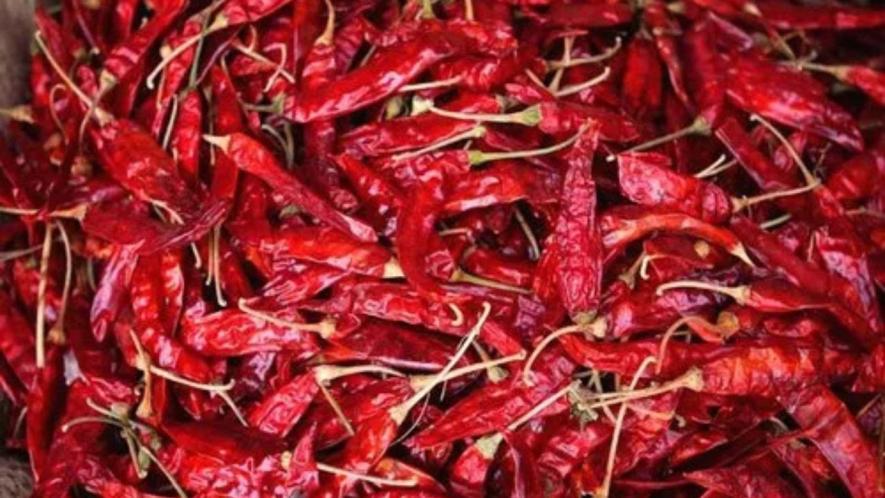
Representational Image. Image Courtesy: IndiaMART
Chilli and salt are not simply commodities in India but carry historical and cultural associations drawn from the country’s custom and history. India has historically been, and still is, the largest producer, consumer and exporter of spices, with the chilli market alone valued at $4.8 billion as of 2025-2026, of which 70% is consumed domestically.
Telangana and Andhra Pradesh are the prime chilli producers in the country which as a whole accounts for half of the global trade in the commodity. The prime varieties that grow in these regions that are considered export quality are teja, guntur sannam, byadagi, US 341. The most prominent customers for this product are India’s neighbours being China, followed by Bangladesh, Sri Lanka and the US.
There has been growth in export by over 15% during the 2024-2025 season, with red chillies alone accounting for over 30% of India’s spice exports. Chillis have health benefits, as these contain capsaicin, which when consumed in moderation can promote heart health and boost the metabolism. However, excessive consumption of chillies can irritate the stomach lining and lead to acidity, gastritis, and in severe cases, stomach ulcers.
A major concern for both trade and consumption is the fact that often, chillis are adulterated with a non-food grade dye, known as Sudan Red, that make the fruit’s colour more vibrant. Adulterators don’t just add the dye to the chilli powder, it is often sprayed onto the whole dried chillies before grinding. This makes the colour penetrate the skin which makes it look like a more natural “high-oil” premium chilli. These colouring dyes are known carcinogens because of which they have been rejected as exports from the European Union, the US, and Taiwan.
For salt, on the other hand, India is the third largest producer behind China and the US, apart from being the largest exporter, accounting for $437.96 million in April 2025. Most of the salt in the country is produced in Gujarat, which accounts for approximately 75% to 85% of salt made in India. Apart from Gujarat, Rajasthan is the leading producer of inland salt, accounting for approximately 7-8% of national production. They are followed by Tamil Nadu that makes 4.7% of the salt. Apart from this, a fraction of the salt is mined from salt deposits in Himachal Pradesh. As an industry, it provides employment to 2 to 3 million people, including small scale farmers known as Agariyas.
Over-consumption of salt, however, is prevalent in India, with the average Indian consuming about 11 to 12 grams whereas the World Health Organisation recommends no more than 5 grams per day. Salt over-consumption has known side effects, such as hypertension in adults, with this afflicting 1 in 4 adults in urban India and 1 in 5 adults in rural India. It is also responsible for 57% of deaths by stroke, and 24% of deaths by coronary heart disease. Apart from this excess salt also forces kidneys to work harder to filter blood which, over an extended duration, can lead to chronic kidney disease.
A study argues that just a 3 gram reduction in the daily consumption of salt in the country could avert 5.8 million strokes and heart attacks over the course of a decade. Apart from the salt that is traditionally added to cooking for taste, there are hidden sources of sodium in traditional Indian snacks, such as pickles and papads, because of how they are prepared, using processes, such as curing, brining and drying that contain high salt concentration.
Consider what 5 grams of salt actually may consist of, this could be two and a half spoons of soy sauce or two large bags of potato chips. A myth that occasionally comes up is that two olives have enough salt to support the human body for a day. This is actually not accurate as there is a difference between salt and sodium. Salt is made of the compound sodium chloride, which contains 40% sodium and 60% chloride. Five grams of salt contains two grams of sodium. Two olives, on the other hand, contain 50-100 milligrams of sodium, and hence would not meet the requirements for a person’s diet. So, where does this myth come from?
A likely source is from Mediterranean monastic traditions, such as Greek Orthodoxy or among the early Christian dessert fathers among whom a meal of bread and two olives was considered to be the absolute bare minimum required to sustain human life. Another source that supports this is the Jewish Rabbinic law, also known as Halakha, where the Kezayit is the least that a person should eat and is about the size of an olive.
The writer is an independent journalist who is presently pursuing his PhD.
Get the latest reports & analysis with people's perspective on Protests, movements & deep analytical videos, discussions of the current affairs in your Telegram app. Subscribe to NewsClick's Telegram channel & get Real-Time updates on stories, as they get published on our website.