





The ‘Riot form’ in Noida and What Comes Next
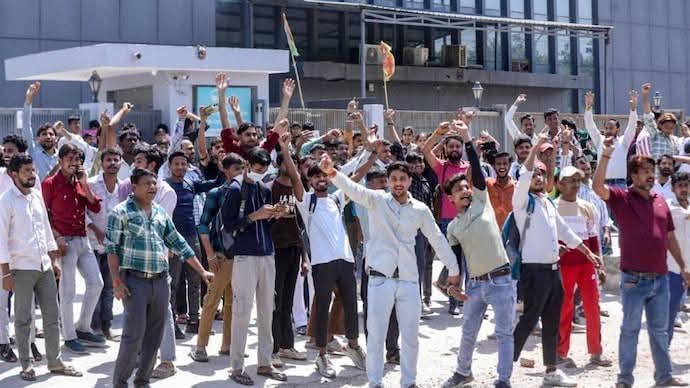
Image Courtesy: CITU Facebook
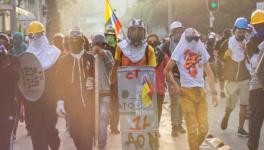
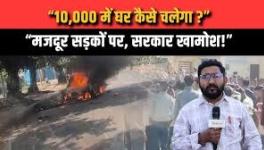
A series of workers’ strikes in India’s Hindi heartland, most recently the riot in Noida’s industrial area, has prompted many commentaries. Among these Saroj Giri’s recent article in The Wire offers one of the most compelling interventions. It argues that a new form of workers’ power is emerging in India’s industrial belts, marked by spontaneous and leaderless direct action that bypasses all traditional mediations. In this form, workers’ hyper-contractualisation functions as an enabling condition, while capital’s own just-in-time production logic has produced its homologue in the flash riot. Its critique of trade unions, stuck in a 1970s welfare-state imaginary is well-placed. So is the observation that social media is being bent toward amplifying real-time direct action in ways that confound both state surveillance and media comprehension. These are genuine theoretical interventions that deserve to be taken seriously. That said, several qualifications are necessary.
The form is not entirely new
Spontaneous and leaderless “riot-form” worker resistance is not a product of neoliberalism alone. Early capitalism was also marked by such eruptions, from the Luddite uprisings to the Captain Swing riots. Marx’s intervention on the Luddites was not merely about machines. It was a warning that spontaneity without political direction tends to misidentify its enemy, targeting the symptom rather than the source, i.e., the underlying relation of production.
The current movements show considerably more sophistication. Workers have been demanding an 8-hour workday, an increased minimum wage, and a double overtime rate. They are identifying capitalist management as the adversary and pressurising the state to intervene. The present pattern of spontaneous eruption, rapid state concession and subsequent demobilisation is also well-attested. While the novelty of the form in the current conjuncture is real, it risks being overstated.
The form is not universal
Since December, wildcat strikes have broken out in roughly 50 to 80 locations, with momentum accelerating after the nationwide strike on 12 February, followed by the Panipat IOCL strike. But beyond Panipat and Noida, this is not yet a generalised form. Instead of reflecting a new workers' awareness, its predominance in industries characterised by heavy casualisation and migrant-dominated workforces implies the form is conditioned by a particular labour regime. Assigning it universality at this point would conflate a conjunctural eruption with a qualitative shift in workers’ subjectivity.
The form was partly produced by state aggression
The riot form is not simply chosen by workers; it is partly produced by the conditions of repression they face. When formal organisation is pre-emptively criminalised through anti-trade union labour law, police action against pickets, and illegally detaining trade union leaders across organisations, workers are structurally pushed toward informal, deniable, leaderless action precisely because it offers some protection against targeted repression.
The Adityanath government’s scramble to identify “instigators” and “conspirators”, its compulsion to invent leaders where none exist, reveals how thoroughly the state’s own repressive logic is confounded by this form. But it also means the form developed in reaction to state action, which both enables and limits its possibilities.
Union absence versus union failure
This brings us to a more contentious theoretical question, as the two positions have very different political implications. Giri’s piece argues that trade unions have been pushed to the margins since at least Maruti Suzuki in 2013, reduced to doing PR for workers who decide for themselves. But there is a question of causality that matters politically.
Did unions fail to enter these spaces despite the possibility existing, suggesting bureaucratisation and class collaboration? Or did capital and the state’s successful prevention of unionisation produce this form as a natural consequence of that absence? Or both? The diagnoses have different implications. Whether we are witnessing the failure of existing trade unions or the redundancy of trade unions as such is not the same question and collapsing them risks premature conclusions.
The discursive sediment of Trade Union campaigns
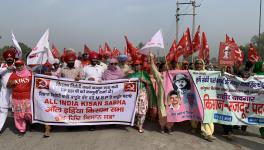
The emergence of the 8-hour demand in a movement with no formal union leadership does not mean it arose from nowhere. It suggests that decades of trade union movement, especially campaigns against the new labour codes carried out by different central and local unions across India in the last few months, have been able to sediment themselves into working-class common sense.
Gramsci envisages in his notion of contradictory consciousness that workers carry fragments of ‘subaltern’ knowledge alongside dominant ideology, and that, in moments of rupture, these fragments can surface. The question is whether this represents a thin discursive inheritance like a slogan floating free of its strategic context or a deeper absorbed understanding of what the 8-hour demand politically means, i.e., the claim that labour-power has limits capital cannot transgress.
External contradictions and the question of consciousness
If we identify the cost-of-living crisis, exacerbated by the LPG shortage, as a trigger, it raises the classic question about the relationship between economic and political consciousness. Lenin’ s point in What Is to Be Done was that trade union consciousness, even militant trade union consciousness, emerges spontaneously from immediate economic grievances, but transformative consciousness requires a political intervention from outside the immediate experience of exploitation. If the immediate trigger is the LPG and cost of living crisis, a crisis of social reproduction hitting those already at subhuman subsistence levels, then the leap in workers’ collective action may be driven more by external contradictions than by any internal development of political consciousness.
This raises a difficult question: why did the pre-existing deplorable labour conditions not trigger this before? What changed is arguably an existential threshold being crossed. A distinction is worth drawing here. One can also argue that casual labour in organised manufacturing, the modern proletariat in the most classical sense, with no property stake, even with no or less ‘sham property’ as Marx noted, has a different subjectivity from other exploited sections who retain some ostensible, even illusory control over petty assets. These casual migrant labourers with little to lose are structurally more likely to generalise their grievances. But structural position alone does not produce political generalisation without some form of mediation.
The question of constructive direction
‘Direct action’ might already be the new form of political organising, or it might contain its elements. The Tahrir Square and recent Bangladesh cases are however sobering, where massive spontaneous mobilisations were eventually captured by Islamist politics, military restoration, or imperialist-backed civil society, precisely because no organised force existed with the political coherence and social roots to offer an alternative direction.
Social media does not resolve this, as platforms are eventually controlled by Capital through algorithms.
The key question is whether the quantitative accumulation of grievances automatically translates into a qualitative political transformation. The redundancy of existing ‘forms’ is not the same as the redundancy of trade unions as such. The present organised sector workplaces have been effectively structured by capital through massive contractualisation, legal repression, and the velocity of hire-and-fire. But workers do not disappear when the shift ends. They live in slums, in peripheral rental settlements and labour colonies where the crisis of social reproduction is felt most acutely. It is precisely this terrain that trade unions and left organisations have largely abandoned in favour of the factory gate and labour commissioner’s office.
What’s next
The ongoing wave of workers’ protests and the “riot form” point to the immediate need to reorient the terrain of labour politics. Capital’s domination structures housing, healthcare, food access, and daily reproduction. A politics that meets workers only at the factory gate concedes the rest of their lives to capital and the state, especially at a time when, in the unorganised sector, capital has left no distinction between the workplace and living space.
A turn toward neighbourhood-based communitarian intervention is not a retreat from class politics. It is class politics, properly understood. It points towards building community collectives as forms of organisation, not as welfare appendages to trade unions, but as political institutions that practice non-exploitative distribution and appropriation at the community level. Collective kitchens, housing cooperatives, community health initiatives, collective procurement against price gouging, community library, or even community spaces, all prefigure in practice what class politics envisions in theory, i.e., people making decisions acting not as isolated individuals, but communities organised around common well-being.
However, there is a risk that these initiatives will be absorbed into NGOisation, becoming service providers rather than forms of counter-power. In that case, the creation of new structures of self-governance and spaces of consciousness risks being reduced to charity disguised in radical rhetoric rather than challenging the status quo. These collectives must therefore be consciously connected to broader demands over planning and democratic control over social surplus, so that the neighbourhood transforms from a site of living into a site of political formation.
The “riot form” may well be the highest expression of workers’ power at this moment. Whether it is also sufficient remains an open question, contingent upon emerging new forms of organising.
The writer is a former public policy professional and currently a doctoral researcher at Dept. of Development Studies, SOAS University of London. Views are personal.
Get the latest reports & analysis with people's perspective on Protests, movements & deep analytical videos, discussions of the current affairs in your Telegram app. Subscribe to NewsClick's Telegram channel & get Real-Time updates on stories, as they get published on our website.