





Rajasthan: Longer Summers, Shrinking Grazing Lands Draining Milk Yields, Hitting Gujjar Livelihoods
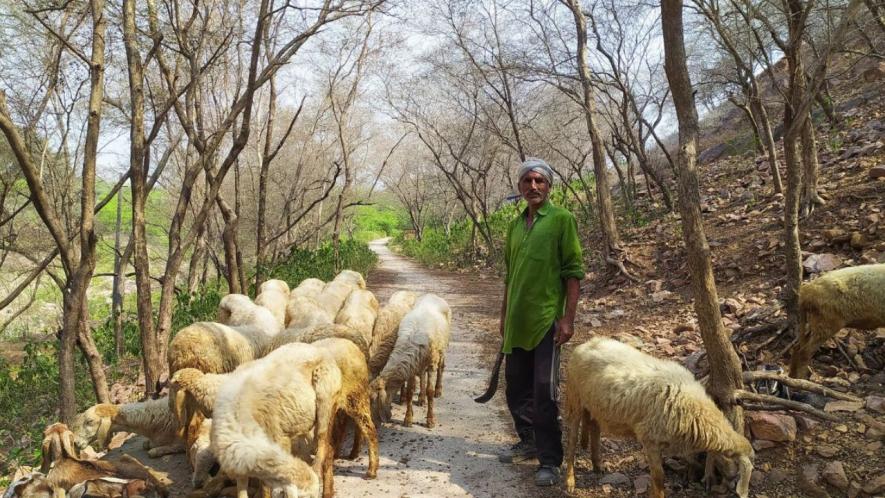
A cattle rearer grazing sheep and goats near Imlia village, Bayana Tehsil, Bharatpur district (Photo - Amarpal Singh Verma, 101Reporters)
Bharatpur, Rajasthan: The Bayana region of Rajasthan's Bharatpur district is known for its animal husbandry-based economy. While all communities here practice animal husbandry, the Gujjar community depends on livestock as its primary source of livelihood. Limited agricultural land and a traditional way of life have made animal husbandry not just an occupation here, but a part of the region’s socio-cultural identity. Over the last decade, however, shifting weather patterns have begun to shake the foundation of this system. Increasing heat, decreasing rainfall, and shrinking pastures have combined to turn animal husbandry into an uncertain and risky profession.
No end to the summer
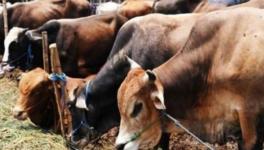
Ramjilal (77), a cattle rearer from Shahpur Dang village, remembers things differently. “I have 36 buffaloes. Earlier, intense heat used to last for a month or two, but now it continues for four to five months. The heat starts as early as February and doesn't end until Diwali. During this time, the animals do not eat fodder properly, drink water repeatedly, and become lethargic. This didn't happen before.”
He told 101Reporters, “Diseases have also increased. Foot-and-Mouth Disease occurs very frequently now. Many times, animals die due to heat and disease — this is the biggest loss.”
Dr Mamta Sikarwar, Technical Officer at the Meteorological Centre in Bharatpur, confirmed what Ramjilal has observed over a lifetime. “The impact of climate change is clearly visible across the entire district. Intense heat and heatwaves usually start from March-April now. Earlier, the temperature stayed around 45-46 degrees Celsius, but now it is reaching 46-48 degrees. In May 2024, it was recorded at 49.2 degrees.” She added that the influence of winter is shrinking and the duration of summer has lengthened. Rainfall averages out on paper, but its timing has become deeply uncertain, Sikarwar added.
The cost in litres
The most immediate economic blow of the heat falls on milk production, which is the backbone of the local economy. Rattiram Gujjar of Shahpur Dang village said, “Reduction in milk during summers has now become a common thing. If a buffalo gives ten litres of milk, it drops to six to eight litres. On top of that, problems of miscarriage have increased, which disrupts the entire future cycle.”
Scientific research supports what he and others are experiencing on the ground. According to an ICAR study, rising temperatures disrupt the heat balance system in animals’ bodies, causing them to eat less fodder and produce less milk. Another study found that during high temperatures, animals expend most of their energy simply keeping their bodies cool, leaving little for output. The Food and Agriculture Organization (FAO) has noted that climate change is increasing pressure on livestock productivity globally, and studies published in the Journal of Dairy Science have found that milk production can drop by 10 to 30 per cent during extreme heat events.
Pritam Gujjar, who owns 15 cows and 35 buffaloes, has watched the change accumulate year by year. “Ten-twelve years ago, there wasn’t this much heat, and there weren’t so many problems. Now winter is only for name’s sake, and we suffer losses every year because of the heat. Last year, ten of my buffaloes had miscarriages; this has become a yearly problem.” The decline in milk production, he said, is not just a daily income problem. “It affects the entire year’s financial planning.”
Increasing pressure on pastures
The milk production is also getting affected due to the reduced quality of fodder available.
Bhajanlal Gujjar of Gazipur village explained, “Earlier, plenty of grass used to grow near the village. We didn’t have to go far. But now pastures have been encroached upon. We have to take the animals several kilometres away to graze.”
Gabbar Singh and Sohanlal, also from Gazipur, told 101Reporters, “Encroachment on pasture land has increased significantly, and because of this, the crisis of fodder for animals has deepened.”
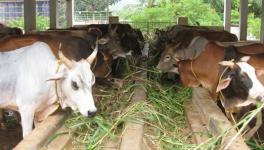
The loss of grazing land has a direct knock-on effect on fodder quality. Senior veterinarian Dr Girish Goyal, Nodal Officer of the Animal Husbandry Department in Bayana, explained: “Earlier, kutti, chopped green fodder, was given to animals. Now, cattle rearers have shifted to bhusa (dry straw) and guar husk. This increases the problem of constipation and intestinal infections in the summer.”
He added that animals need green fodder to avoid these ailments, but according to Shivram Gujjar, a cattle rearer from Imlia village, green fodder is not available in the summer.
“Where do we feed them green fodder from?” he asked.
Shivram Gujjar explained that encroachment on pasture land has increased, rainfall has become irregular, and grass no longer grows the way it used to. “Earlier, green fodder was available for months after the monsoon. Now it dries up in a few days.” Meanwhile, cattle rearers are forced to buy expensive dry fodder, pushing up costs. A study by the Council on Energy, Environment and Water (CEEW) confirms this bind, three out of every four cattle rearers report a shortage of fodder and animal feed.
Shishram Gujjar of Imlia village says he has tried raising the alarm. "Forests have decreased, and farming has started on pasture lands. We have to go very far to graze our sheep, goats, and cows. We have complained about encroachment many times, but no one listens.”
Mounting crisis
Dr Goyal has watched the health consequences mount over the years. “This is a hilly and rocky area that was always warm, but now both the intensity and duration of the heat have increased. Here, 80 to 90 per cent of the livestock are buffaloes and buffaloes are affected more because they have lower heat tolerance.” Heat stress and heatstroke in animals are becoming more common, he said. When temperatures climb too high, animals cannot regulate their body temperature, and milk production falls sharply.
The toll goes beyond lost milk. “Every year, 50 to 100 buffaloes die due to intestinal infections, especially in the Dang region. A buffalo costs between one or one-and-a-half lakh rupees, and the death of one animal means the family’s back is broken.” Cases of miscarriage also rise through the summer months, cutting into the future income of cattle rearers whose entire financial cycle depends on the next generation of animals.
The Animal Husbandry Department has recently issued an advisory warning that problems like dehydration, heatstroke, fever, diarrhoea, and miscarriage are on the rise due to increasing heat and heatwaves. Unseasonal rain and hailstorms have further weakened animal immunity, raising the risk of infectious diseases. Experts said that shade, adequate cold water, nutritious fodder, and special care during heatwaves can help, but implementing these measures requires resources that most cattle rearers simply do not have.
The cumulative pressure — longer summers, lost pastures, rising costs, dead animals — is showing up in the numbers. According to the 2019 livestock census, there were approximately 1.25 lakh animals in Bayana Tehsil. Dr Goyal estimated that, though the 2024-25 census figures are not yet available, there has been a decline of roughly 30 per cent in recent years.
Jagram Gujjar in Bayana has seen it in his own neighbourhood. “Earlier, every house had 100-150 animals. Now that number has reduced significantly. People don’t even want to keep that many animals anymore.” Many have left the profession altogether, preferring small jobs in towns.
It is a trend that worries Dr Goyal. “Many youths are doing small jobs for ten thousand rupees a month. But if they took proper training and raised even five animals, they could earn fifteen to twenty thousand rupees monthly.” Jagram is less optimistic about convincing them: “Youth no longer want to do animal husbandry. They feel it involves more hard work and less profit.”
A study by Associate Professor Amlan Das Gupta at OP Jindal Global University underlines the wider stakes; the economic and nutritional challenges faced by small dairy farmers due to rising temperatures extend beyond individual families, posing a threat to national milk production and food security.
Amarpal Singh Verma is a freelance journalist and a member of 101Reporters, a pan-India network of grassroots reporters.
Get the latest reports & analysis with people's perspective on Protests, movements & deep analytical videos, discussions of the current affairs in your Telegram app. Subscribe to NewsClick's Telegram channel & get Real-Time updates on stories, as they get published on our website.