





MP: MSP Uncertainty Pushes Khargone Farmers Away From Summer Moong

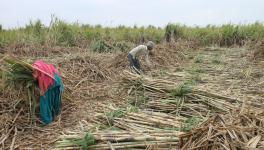
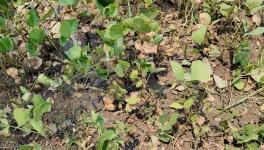
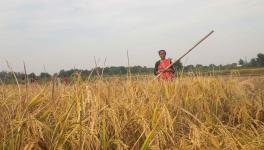
The moong crop in Khargone is showing good yields (Photo - Amit Bhatore, 101Reporters).
Khargone, Madhya Pradesh: In Madhya Pradesh's Khargone district, the area under summer moong cultivation has declined sharply this year. Once considered a short-duration, low-water, high-return crop, moong is now becoming a casualty of uncertain government policy. Delays in procurement at the Minimum Support Price last year, farmer protests, and the absence of clear signals regarding procurement this year have pushed many farmers away from the crop, affecting not only incomes but also crop cycles and soil health.
The area under summer moong cultivation in Khargone district increased from 15,000 hectares in 2024 to 33,000 hectares in 2025, before declining to 25,000 hectares in 2026, according to the District Farmers' Welfare and Agriculture Development Department.
The decline is striking because irrigation coverage in the district has expanded in recent years, and water availability has improved. Many farmers have sufficient irrigation facilities, but are still leaving fields empty instead of sowing moong.
Farmer Peeru Gurjar from Raibidpura village said farmers had hoped to grow moong as a third crop after kharif and rabi. “We are choosing crops based more on government signals than the weather,” he said. “If there is no guarantee of procurement, we are not ready to take the risk. Last year, there was no clarity on MSP procurement when the crop was ready, so we did not grow moong this time.”
Farmer Arvind Patidar from Gavasan village echoed the concern. “Moong gets ready in 60 to 65 days. If the government procures it, we get a good price, but Mandi rates fall. We faced a lot of trouble last year, so we reduced the area this time. Even though we have irrigation facilities and could have grown moong, if there is no procurement, how will we recover the cost?”
Procurement after protests
Last year's procurement did not begin without resistance from farmers. The uncertainty deepened after the government raised concerns that some farmers were using herbicides to dry moong crops quickly, potentially affecting food safety. Statements were also made at the level of the Agriculture Production Commissioner, indicating that procurement might not take place.
Gopal Patidar, organisation minister of the Rashtriya Kisan Mazdoor Mahasangh, said farmers responded with protests, complaints, and demonstrations across the district. Procurement at MSP eventually began after pressure mounted, but by then, many farmers had already sold their produce in the open market at lower prices.
Last year, 45,207 quintals of moong arrived at the Khargone agricultural produce market. Prices ranged from Rs 3,000 to Rs 8,000 per quintal, with an average price of Rs 6,551, well below the MSP of Rs 8,682 per quintal fixed under the Government of India’s Price Support Scheme.
Farmer registrations for MSP procurement began on June 10, 2025, and procurement started only on July 7, 2025. By then, hundreds of farmers had already sold their produce in the market.
Uncertainty returns
Even this year, farmers are waiting for a clear announcement on moong procurement. Khargone District Marketing Officer Rohit Srivastava said instructions regarding procurement had not yet been received. “At present, wheat and gram are being procured,” he said.
Meanwhile, the state government appears to be shifting its focus towards urad cultivation. Farmers’ Welfare and Agriculture Development Minister Edal Singh Kanshana recently said the government was encouraging urad cultivation and had announced a bonus of Rs 600 per quintal on urad purchases.
“It is an appeal to farmers to cultivate as much urad as possible, so that they get the benefit of this bonus and the next harvest can also be prepared on time,” he said.
SS Rajput, Deputy Director of the Farmers' Welfare and Agriculture Development Department, said no instructions had yet been received regarding MSP procurement of moong.
“There is, however, information coming in about a bonus on urad,” he said. “Another reason for the decline in moong area is that farmers are shifting to vegetables and other crops. Farmers keep changing crops.”
Farmer Ajay Sharma has already shifted to maize this season. “It will also provide sufficient fodder for animals,” he said.
Waiting for procurement
Not every farmer stepped back from moong cultivation. Some who sowed the crop this year are now anxiously waiting for procurement announcements.
Farmer Santosh Patidar from Ubdi village said, “This time I have sown moong on three acres. The crop is about two months old. In a week or two, we will harvest it. But there is still no information about procurement. If MSP procurement does not happen, there will be problems. The government should start registration soon.”
Farmer Gajanand Bake from Kaladha village said he cultivated moong on eight acres last year and produced 40 quintals. “Since procurement happened at MSP, I got a good profit,” he said. “Moong cultivation requires low cost and gives returns in 60 to 70 days. That is why I have sown it again this year. However, there is confusion about MSP procurement this time. If procurement does not happen, I will have to sell at lower prices in the open market, which will cause losses.”
Vinod Jain, president of the grain traders’ association at the Khargone agricultural produce market, said new moong arrivals had already begun.
“This year's arrivals have started. Prices are between Rs 8,100 and Rs 8,500 per quintal. Currently, arrivals are around 100 to 150 quintals per day,” he said.
However, on May 5, 2026, prices in the market were recorded between Rs 6,096 and Rs 7,640 per quintal, already below last year’s MSP of Rs 8,682.
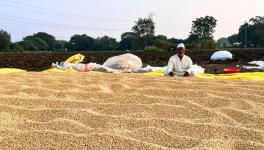
Farmer Nilesh Patidar said the absence of procurement also creates storage pressures. “If moong is not purchased, storage becomes the biggest challenge. Farmers who do not have storage facilities sell moong in the market at a low price,” he said.
What’s at stake
Dr RK Singh, scientist at Krishi Vigyan Kendra Khargone, said the agronomic benefits of moong remain significant despite policy uncertainty.
“Summer moong is beneficial for farmers. It provides higher profit at lower cost,” he said. “The crop is sown in March and is ready in 65 to 70 days. It requires about 8 kg of seed per acre, with an average yield of 6 to 7 quintals. The crop is less prone to disease, requires minimal fertiliser, and since moong is a legume, it increases nitrogen in the soil, benefiting the next crop. The falling leaves also increase organic matter.”
Ramshankar Jat, assistant soil testing officer at the district-level laboratory, said moong cultivation improves nitrogen levels and organic matter in the soil, though crop rotation remains key to maintaining soil health.
“Continuous harvesting of the same crop on the same land reduces production capacity, but that problem can be avoided if farmers alternate moong with other crops,” he said.
Shyamsingh Panwar, Malwa region youth head of the Bharatiya Kisan Sangh, warned that continued uncertainty could further reduce cultivation in the coming years.
“Farmers who have sown moong this year are demanding that procurement preparations and the registration process be announced now, so that there is no problem at the time of harvest,” he said. “If moong is not procured at MSP, protests will be held.”
Amit Bhatore is a freelance journalist and a member of 101Reporters, a pan-India network of grassroots reporters.
Get the latest reports & analysis with people's perspective on Protests, movements & deep analytical videos, discussions of the current affairs in your Telegram app. Subscribe to NewsClick's Telegram channel & get Real-Time updates on stories, as they get published on our website.