






Kafka Would Understand: Even Dead Must Prove They’re Dead
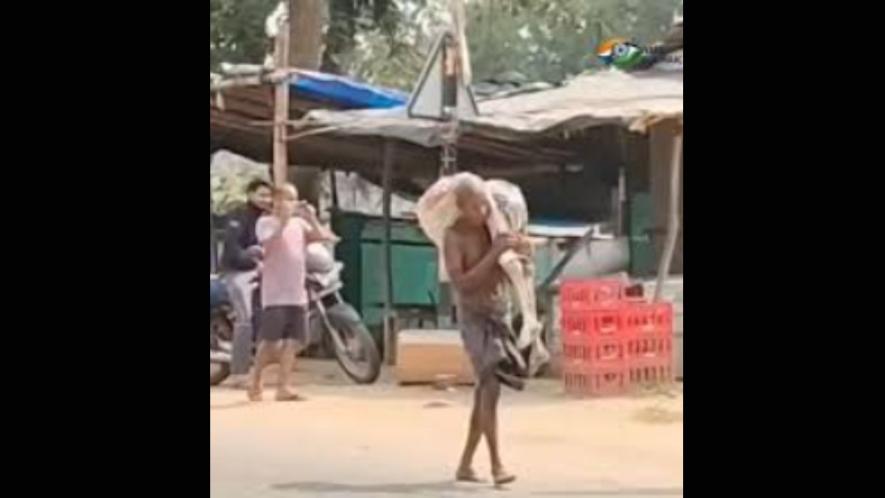
Image Courtesy: yugsuchaknews Instagram
There are stories that disturb you for a moment, and then there are stories that stay quietly, stubbornly refusing to leave your mind even when the day has moved on. This is one of the latter. In Keonjhar district, in Dianali village of Odisha, Jitu Munda exhumes the body of his sister not out of ritual, not out of grief alone, but to prove to a bank that she is dead. To prove death. To authenticate absence. To satisfy a system that demands documentation even when reality lies buried in front of it.
What makes this even more unsettling is how ordinary the story is before it turns extraordinary. Jitu Munda’s 56-year-old sister, Kalara, had been living a life familiar to millions marked by loss, labour, and quiet resilience. After the deaths of her husband and son, she returned to her maternal home, working as a daily wage labourer to sustain herself. A few months before she died, she sold her livestock and deposited Rs.19,300 in a bank. After her death, Jitu Munda did what any brother would do. He went to the bank, again and again, trying to access the money she had left behind. But each visit ended the same way with refusal, with procedure, with the demand for proof. Proof of death, as if death itself were not proof enough.
“When the bank manager refused to listen and kept asking for proof, I got frustrated,” Jitu said. “I brought the skeleton to show that she had died.” There is something profoundly disturbing about this sentence. Not because of what it describes, but because of what it reveals. Frustration here is not sudden, it is cumulative. It is built through repeated encounters with a system that does not bend, does not listen, does not see. By the time he carried her remains to the bank, the act was no longer unthinkable. It had, in a tragic way, become logical. At the heart of this incident is a quiet violence. Not the visible kind, not the kind that makes headlines through spectacle, but the slow, procedural violence of indifference. A system that insists on paperwork over testimony, certification over truth, and compliance over compassion. The brother did not exhume his sister because he doubted her death. He did it because the system did.
What does it mean when grief itself must be documented? When mourning requires proof? When the word of a family, the presence of a body, the memory of a life lived all of it is insufficient unless stamped, signed, and uploaded into a digital record? This is where the story becomes more than just an isolated incident. It becomes a mirror. It reflects a structure where delay is normalized, where inefficiency is endured, and where people, especially those on the margins must navigate a maze of requirements that often feel both excessive and arbitrary. The idea of the ‘Kafkaesque’ is often used loosely, but here it feels precise. Not because the system is intentionally cruel, but because it is indifferent to the point of cruelty. The rules exist, the procedures exist, the portals exist but they operate in a way that disconnects entirely from lived realities.
There is also something deeply revealing about the role of the bank in this story. A bank is supposed to be a place of trust, of security, of safeguarding what people hold dear. But here, it becomes a gatekeeper of legitimacy. The brother’s claim, perhaps a modest sum, perhaps a significant one, becomes contingent on proving something that should not require proof in such a brutal way. The institution demands certainty, but offers no flexibility in how that certainty can be established. And then there is the digital layer.
Increasingly, governance and services are being mediated through digital systems. In theory, this promises efficiency, transparency, and accessibility. In practice, it often produces a new kind of exclusion. The digital divide is not just about access to devices or the internet. It is about familiarity, literacy, confidence, and the ability to navigate systems that are designed without considering those who will use them.
For many, uploading a document is a trivial act. For others, it is an obstacle. It may require travel, assistance, money, and time. It may involve multiple visits to offices, repeated rejections, and a growing sense of helplessness. In such a context, the demand for “proper documentation” is not neutral, it is burdensome. It shifts the responsibility entirely onto the individual, without acknowledging the uneven terrain they are forced to walk. The brother’s act, then, is not just about desperation. It is about compulsion. It is about reaching a point where the only way to be heard is to perform proof in the most literal, undeniable way possible.
This is where the story becomes uncomfortable for all of us. It is easy to frame it as an extreme case, an exception, an anomaly. But doing so risks missing the pattern it reveals. How many smaller, less visible acts of compliance are taking place every day? How many people are bending, adjusting, waiting, and enduring quietly without their stories ever being told? The tragedy here is not only that a body was exhumed. It is that it had to be. That a brother, in the process of seeking what was rightfully his, was forced into an act that disrupted the dignity of death itself.
There is also something about the emotional toll that often goes unspoken. Grief is not linear, and it is rarely neat. To reopen a grave is to reopen a wound. To turn a moment of loss into an administrative task is to blur the boundary between the personal and the procedural in a way that is deeply unsettling. And yet, the system remains intact. It processes documents, not emotions. It recognizes forms, not experiences. It operates on a logic that is consistent, but not necessarily just.
So, what does one do with a story like this? It is not enough to feel disturbed. Discomfort, if it remains passive, changes nothing. The question is whether such incidents can push us to rethink how systems are designed and implemented. Whether there is space for flexibility, for discretion, for empathy within structures that are often built on uniformity.
There is a tendency to celebrate digitisation, to frame it as progress, as inevitability. And in many ways, it is. But progress that leaves people behind, that creates new forms of exclusion, that demands adaptation without providing support such progress is uneven. It benefits some while burdening others.
The story from Odisha is not just a reminder about a brother and his sister. It is about the distance between policy and practice, between intention and impact. It is about what happens when systems forget the people they are meant to serve. And perhaps that is why it lingers. Because it is not just shocking it is revealing. It exposes a fault line that runs through many aspects of governance and everyday life. In the end, the image that remains is stark. A man standing at the intersection of grief and bureaucracy, holding evidence that should never have been required. It is an image that asks a simple but urgent question: when systems become so rigid that they demand the impossible, who pays the price?
The writer is Assistant Professor, Department of Sociology, Maitreyi College, University of Delhi. The views are personal.
Get the latest reports & analysis with people's perspective on Protests, movements & deep analytical videos, discussions of the current affairs in your Telegram app. Subscribe to NewsClick's Telegram channel & get Real-Time updates on stories, as they get published on our website.