





J&K: Villages Await Elected Panchayats as Development Decisions Shift From Grassroots
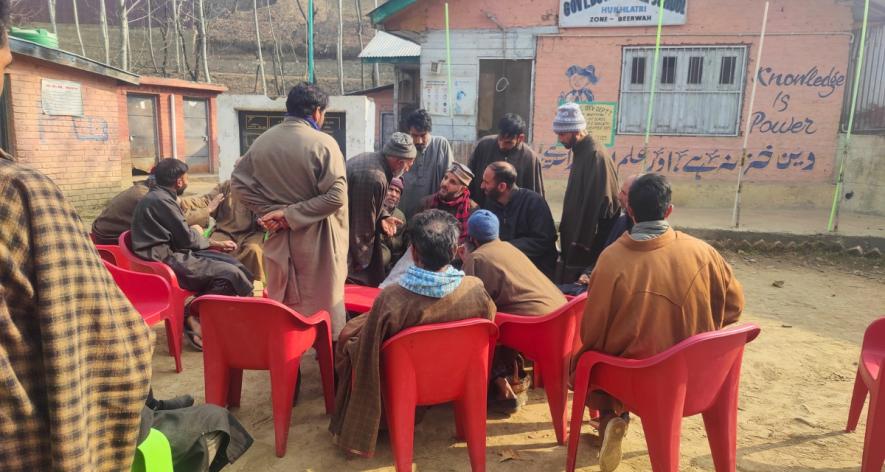
Gram Sabha meeting at Hukhlatri, Budgam, in the absence of an elected panchayat body (Photo - Mukhtar Dar, 101Reporters)
Budgam: For villagers in Zoogi B Panchayat of Budgam district, heavy rain brings the annual threat of water spilling from three canals onto their agricultural fields. They had begun building protective bunds to keep the water out, but the work stopped after the elected Panchayat's term ended. With villagers no longer controlling the development funds, the unfinished bunds have remained that way, leaving their fields vulnerable every monsoon.
Mohammad Maqbool Mir, former Sarpanch of Zoogi B said the Panchayat had decided to construct protective bunds along the Ganie Mohala Kul, Ahangar Mohala Kul and Muser Kul in phases. Some stretches were completed during its tenure, but the work had to be halted after the Panchayat was dissolved
“The work on these canals remained unfinished. As a result, whenever it rains heavily, agricultural fields continue to be damaged,” Mir told 101Reporters.
Zoogi B is one example of how the absence of elected Panchayat bodies has affected development in rural Jammu and Kashmir. The terms of the two-tier Panchayati Raj institutions, including Sarpanches, Panches and Block Development Councils (BDCs), ended in January 2024. The term of the District Development Councils (DDCs), the last surviving tier, ended in February 2026. Panchayat elections have not been held since.
Why are Panchayat elections delayed in J&K?
The delay has continued even as the legal framework provides for periodic elections to Panchayat bodies.
Section 42(1) of the Jammu and Kashmir Panchayati Raj Act, 1989, provides a timeline for holding Panchayat elections, while Article 243E of the Constitution requires Panchayats to have a five-year term and provides for elections before the expiry of that term. If a Panchayat is dissolved before the end of its term, elections are ordinarily required within six months.
Advocate Naveed Bhuktiyar, who practises at the High Court of Jammu and Kashmir and has spoken publicly against the delay in holding Panchayat elections, said the government was failing to comply with the law.
“It is unfortunate that Panchayat elections are being unnecessarily delayed in J&K, despite the clear law on the subject that elections shall be conducted every five years,” he said.
He said the delay was also weakening constitutional decentralisation by keeping elected local representatives out of decision-making.
The government, however, has cited the ongoing delimitation exercise and the need to provide reservation for Other Backward Classes as reasons for the delay. On February 19, 2026, Chief Minister Omar Abdullah cited these processes as reasons for not holding the elections.
Delimitation involves determining which villages and areas fall within particular electoral units, while OBC reservation determines which local-body seats will be reserved for candidates from Other Backward Classes. The government has said these processes need to be completed before elections are held.
Naveed said that even if there were gaps in the J&K Panchayati Raj Act, after altering the Article 370, Article 243E provided a constitutional framework for timely elections.
“Therefore, even if there were any gaps in the Jammu and Kashmir Panchayati Raj Act, 1989, Article 243E of the Constitution has effectively filled that legal vacuum by providing a clear constitutional framework for the timely conduct of Panchayat elections,” he said.
The delay is not new to Jammu and Kashmir. Since the J&K Panchayati Raj Act, 1989 came into force, Panchayat elections have been held only three times — in 2001, 2011 and 2018 — with gaps between successive elections.
Development Works Left Unfinished
The absence of elected Panchayats is being felt in villages through stalled development works.
In Chewdara Panchayat of Beerwah in Budgam district, the elected Panchayat had identified land for a playground because the village did not have one. Some work was started during the Panchayat's tenure, but no further development took place after its term ended.
Former Sarpanch Bilal Ahmad Mir said the absence of an elected Panchayat had created a vacuum in villages.
After the Panchayat body’s term ends, there is no one responsible for identifying and prioritising the collective needs of the village, he said. While residents continue to approach officials and elected legislators with individual demands, there is no elected village-level body to decide which needs should receive priority.
Mir said residents with better connections with government officials or the concerned MLA were more likely to get their work done.
The change is not limited to individual projects. Former Panchayat representatives and officials say the absence of elected bodies has also altered how development funds are controlled and allocated.
Fewer Funds, Less Local Control
When elected Panchayat bodies were functioning, each Panchayat in Jammu and Kashmir received an annual PRI fund of around Rs 23.3 lakhs, according to Panchayat members and a Village Level Worker interviewed for this story. The utilisation of these funds was decided through the Gram Sabha according to local development priorities.
After the elected Panchayats completed their terms, however, the annual allocation available at the Panchayat level was reduced to around Rs 12 lakhs, according to the same sources. The remaining funds were diverted to the District Capex Budget, including funds associated with the BDCs and DDCs.
A rural development officer, who asked not to be identified, said that when elected Panchayat bodies were functioning, the entire Panchayat-level allocation was available for development works within the Gram Panchayat area.
After the Panchayats' terms ended in 2024, the funds were divided into two portions, the officer said. One portion continued to be utilised through the Gram Sabha, while the remaining amount was shifted to the District Capex Fund.
According to the officer, only around half of the PRI amount is now being utilised through the Gram Sabha, while the remaining funds are being handled by the administration.
The J&K Panchayati Raj Act, 1989, allows the government to appoint an Administrator or a committee of Administrators to discharge the functions of a Panchayat after its elected body ceases to function. However, the requirement for bottom-up planning through the Gram Sabha remains.
The shift in control has changed how development priorities are determined at the village level, former Panchayat representatives said.
Mir said that when elected Panchayats were functioning, each village received an equal share of funds and local representatives could decide which works needed to be taken up. With the reduction in Panchayat-level funds, he said, decisions were increasingly being made by officials rather than elected representatives.
This has also created a new burden for the administration, where officials are now required to deal with development demands from multiple villages that previously had elected representatives responsible for identifying and prioritising them.
Waste Management Becomes Another Casualty
Under the Swachh Bharat Mission (Grameen) Phase II, the Rural Development and Panchayati Raj Department constructed waste segregation sheds at the Gram Panchayat level across Jammu and Kashmir.
In response to a query by MLA Bashir Ahmad Shah Veeri, the administration said that waste segregation sheds had been constructed at a total cost of Rs 6,814.60 lakhs. According to the government, 1,851 sheds with 1,229 functional units were built in 2023-24, followed by 156 sheds with 166 functional units in 2024-25 and 140 sheds with 96 functional units in 2025-26.
Irfan Magrey, former BDC Chairman of Watrahail Block, said the segregation sheds were constructed in coordination with elected Panchayat bodies.
The government was responsible for creating the infrastructure, while the Panchayats were expected to mobilise community contributions and manage routine waste collection, including the collection and transportation of household waste to the segregation sheds, he said.
“However, soon after these sheds were constructed, the tenure of the Panchayat bodies ended,” Magrey said. “With no elected local authority to oversee the system, responsibility became unclear.”
He said villagers began dumping waste indiscriminately in and around the sheds, resulting in the accumulation of garbage and creating sanitation and environmental problems.
A Rural Development Department official in Budgam, who spoke on condition of anonymity, said the administration could provide infrastructure but routine waste-management activities remained the responsibility of local Panchayats.
“The Panchayats are responsible for generating funds to run routine activities such as collecting waste from households, segregation and meeting vehicle-related expenses,” the official said.
Without anyone at the Panchayat level to manage these activities, it becomes difficult for the administration to ensure that villages remain clean, the official added.
A Gap in Grassroots Governance
The absence of elected Panchayats has also raised questions about how the government’s earlier attempts to bring administration closer to villages are functioning in their absence.
The Back to Village programme was designed to connect government administration with rural communities and identify local development priorities. The delay in Panchayat elections, however, has left villages without the elected institutions that were intended to play a central role in grassroots decision-making.
Dr Sheikh Ghulam Rasool, an environmentalist and activist who has trained and motivated Panchs and Sarpanchs across Kashmir, said the absence of empowered local institutions had broader implications for decentralisation.
Empowered Panchayats, particularly the BDCs and DDCs, decentralise decision-making, finances and administrative authority, he said. This can reduce the concentration of power traditionally exercised by MLAs and political leaders.
As a result, he argued, there may be little political incentive to ensure timely elections or devolve meaningful powers to local institutions.
“Grassroots democracy cannot thrive where laws permit delay and politics resists devolution,” Sheikh said.
Rafaqat Sonawari, spokesperson for the All-Jammu and Kashmir Panchayat Association, said Panchayat elections had at times been delayed because of security concerns and at other times because the government had been unwilling to conduct them.
He also cited electoral-roll revisions as one factor that could delay elections.
“If the present government conducts the elections now, the MLAs would lose their influence over the blocks, because today’s MLA is equivalent to a Sarpanch,” he said.
The repeated gaps between Panchayat elections have meant that grassroots democratic institutions in Jammu and Kashmir have struggled to function continuously. The current gap, however, has extended beyond the expiry of the elected Panchayats' terms and now affects all three tiers of the Panchayati Raj system.
Mukhtar Dar is a freelance journalist and a member of 101Reporters, a pan-India network of grassroots reporters.
Get the latest reports & analysis with people's perspective on Protests, movements & deep analytical videos, discussions of the current affairs in your Telegram app. Subscribe to NewsClick's Telegram channel & get Real-Time updates on stories, as they get published on our website.