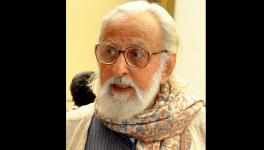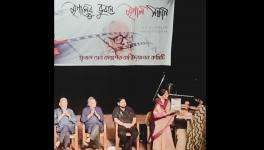






Jaladhar Chatterjee: Aristocratic Heritage, Progressive Soul
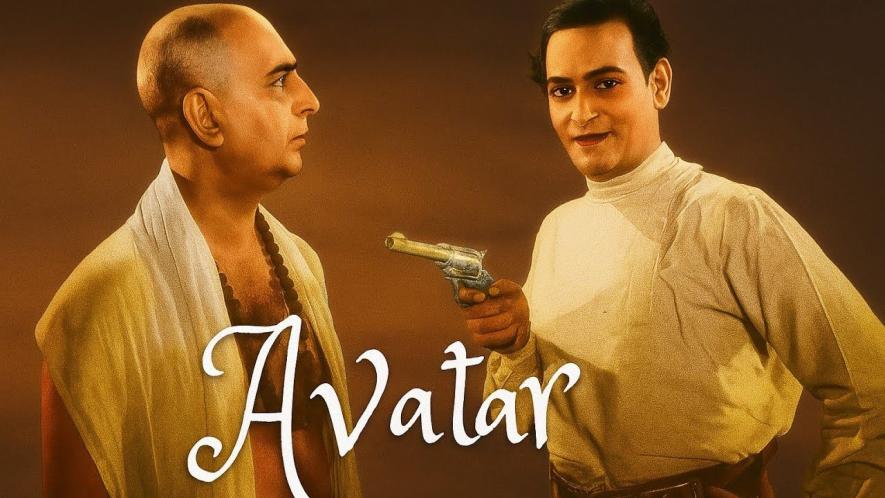
Poster of Avatar written by Jaladhar Chatterjee.
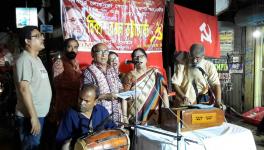
"আমার কবিতা হারায়ে ফেলেছি" — "I have lost my poems"
— Jaladhar Chatterjee’s last great song, sung by Anup Ghoshal
Born in 1890 in Jessore — a district of undivided Bengal, now in present-day Bangladesh — Jaladhar Chatterjee (also rendered Jaladhar Chattopadhyay in its Sanskritised form) came into the world at a moment when Bengali cultural life was trembling on the cusp of transformation.
The Bengal Renaissance, set into motion by reformers from Ram Mohan Roy to Bankimchandra Chattopadhyay and reaching its flowering in Rabindranath Tagore, had already begun remaking the intellectual and literary landscape of the subcontinent.
Jessore, a fertile district of the Bengal delta long associated with landed aristocracy and cultural patronage, was the kind of place where gifted young men from privileged families would turn to literature and the arts as much as to law or civil services.
Jaladhar was born into one such aristocratic family, a background that gave him the leisure to cultivate artistic sensibilities and the moral authority to critique the very social order from which he came. His life trajectory — from the son of a zamindar who wrote plays, to a playwright who challenged casteism, Brahminical exclusion, and communal violence — speaks of a particular species of Bengali reformism: the insider who becomes the outsider's champion.
Entry Into Bengali Commercial Theatre in Early 20th Century
To understand Jaladhar Chatterjee's significance, one must first understand the theatrical world into which he stepped. By the early 20th century, the Bengali commercial stage, headquartered in Calcutta, was vibrant in Asia. Its lineage ran from Michael Madhusudan Dutt's pioneering plays of the 1860s through the grand, mythologically charged productions of Girish Chandra Ghosh, who had famously made Minerva Theatre and Star Theatre the “twin temples” of popular Bengali drama in the 19th century.
The great playhouses of North Calcutta were storied institutions. Star Theatre at 75/3/4, Bidhan Sarani (then Cornwallis Street), had witnessed the debut of legendary performers and served as the crucible for some of the finest theatrical productions in the subcontinent.
Minerva Theatre, inaugurated on January 28, 1893 at 6/1, Beadon Street, had hosted Girish Chandra Ghosh's final spectacular performances; it burned in 1922 but was rebuilt and reopened in 1925. Rangmahal, Natyabharati, and several other venues completed the galaxy of Calcutta's theatrical life.
The dominant mode of commercial Bengali theatre in this period leaned heavily on mythological and devotional subjects — the lives of gods, the epics, romantic legends drawn from ancient texts. Plays about Rama and Sita, about Krishna and Radha, about figures from the Puranas filled the bills, season after season. Audiences flocked to see familiar stories rendered with spectacular scenery, emotional music, and acting styles that owed something to both the indigenous jatra tradition and Victorian theatre, which educated Bengalis had absorbed through English education.
Into this world walked Jaladhar Chatterjee, and he chose to write about something entirely different.
Theatre of Social Reform: A Voice Ahead of His Time
Jaladhar's most enduring distinction as a playwright was his insistence on writing about the world as it actually was — its injustices, hypocrisies, failures, compassion — rather than about a mythological past. This made him, in the words that have been applied to him, a playwright “far ahead of his age.” His progressivism antedated by nearly two decades the organised cultural politics of the Indian People's Theatre Association (IPTA), which was formally founded on May 25, 1943, in Bombay and became the primary institutional home for Left-leaning progressive theatre in the sub-continent.
Jaladhar was doing this work — writing on casteism, women's empowerment, communal violence, and social reform — before IPTA gave it an ideological vocabulary or organisational structure.
His play Osoborna ('the untouchable' or 'the excluded') tackled casteism directly, daring to put on the commercial stage a subject that polite theatrical society preferred to suppress. His play Mandir Prabesh ('Entry into the Temple') confronted the Brahminical prohibition against lower castes entering places of worship, a theme that resonated with the growing Dalit assertion movements of the era and triggered debates that would occupy reformers across India throughout the mid-20th century. Ranga Rakhi, Rather Thakur, and Dharmaadrohi further probed the hypocrisies and contradictions of religious orthodoxy and social hierarchy.
On the question of women's empowerment, Praner Dabi ('The Demand of Life') articulated the case for women's autonomy and dignity, placing a fully imagined female interiority at the centre of theatrical drama at a time when female characters in popular theatre were more often the objects of pathos, virtue, or temptation, than autonomous subjects in their own right. Ohingsha (Non-violence) brought a Gandhian ethical question to the commercial stage. These were not small acts of artistic courage in the world of 1920s and 1930s Bengali theatre.
Jaladhar’s most explicitly political play, Thamao Raktapat (Stop the Bloodshed), was written in response to the catastrophe of the Great Calcutta Killings of August 1946, when Direct Action Day, called by the Muslim League on August 16, triggered huge communal violence. The casualty estimates range between 5,000-10,000, with tens of thousands displaced, as the city was consumed by fires, looting, and targeted massacres. The violence lasted from August 16-19, after which Bengal was placed under the Viceroy's direct rule.
Thamao Raktapat was Jaladhar's anguished public appeal to halt the bloodshed — a playwright using his art not to entertain but to plead, to humanise, to call Bengal back from the abyss. The play went into a second edition, its relevance extending past the country’s Independence into the chaos of Partition itself.
Major Plays and Their Stage Lives
The play that drew the widest public attention to Jaladhar Chatterjee was Reetimoto Natok (A Play According to Custom' or 'A Proper Play), a title with characteristic irony. It was adapted into a remarkable film titled Talkie of Talkies (also known by its Bengali alternative title Dasturmoto Talkie) in 1937, directed by none other than Natyacharya Shishir Kumar Bhaduri (1889–1959).
Bhaduri, the pioneer of modern Bengali theatre, professor of English at Metropolitan College (present-day Vidyasagar College), and one of the most formidable actor-directors in the history of Indian stage, was known for bringing an unusual intellectual rigour and insistence on naturalism to a theatrical tradition that had long favoured declamation and spectacle. That he chose to adapt Jaladhar's play was itself an endorsement of the highest order. The film starred Bhaduri alongside Ahindra Choudhury, Jahar Ganguli, and Kankabati, and is described by IMDB as a film about 'life imitating art' — a satirical comedy about a professor whose sister defies his wishes and joins the stage, leading to tragedy. Bhaduri was awarded the Padma Bhushan in 1959, though he famously refused the award on principle.
Equally significant was PWD, a play whose title borrowed the bureaucratic abbreviation for the Public Works Department, a characteristically ironic framing that placed the language of colonial administration in the service of social satire. PWD ran for over two years on the Calcutta stage, an extraordinary run, and starred Durgadas Banerjee (1893–1943), the matinee idol of early Bengali cinema and theatre.
Banerjee, born into a zamindar family in Kalikapur in the 24 Parganas and trained at the Government College of Art and Craft, made his stage debut under Sisir Bhaduri and went on to become the biggest star of Madan Theatres. A performer of poise and composure, whose aristocratic lineage was credited with shaping his acting style, Banerjee's influence extended through his poise to later actors, such as Chhabi Biswas.
In recognition of the extraordinary success of PWD, both Jaladhar as a writer and Durgadas as an actor were awarded a Golden Pen and Inkstand — a formal honour that testified to the cultural seriousness with which the Calcutta theatrical establishment regarded their achievement.
Abatar ('The Incarnation') was another of Jaladhar's major that was adapted into the 1941 Bengali film of the same name. It was directed by Premankur Atorthy (1890–1964). Atorthy, a man of extraordinary range — novelist, journalist, and film director — was responsible for New Theatres' very first talkie, Dena Paona, and had established himself as a filmmaker committed to literary and intellectually serious cinema. The cast of Avatar included Durgadas Bannerjee, Ahindra Choudhury, Jyotsna Gupta, Tulsi Lahiri, and Utpal Sen. The film wove together mythological allegory with satire on contemporary society and the industrialising economy of wartime India.
Beyond these two filmed adaptations, Jaladhar directed two films himself. Bahubrihi took its title from a compound Sanskrit grammatical form — the bahuvrihi compound — a word that in common Bengali usage refers to someone who possesses many things, an ironic framing suited to social comedy. Bhuler Baluchare (On the Sands of Illusion or 'Stranded in Error') was an even more ambitious undertaking, a film on mental health, remarkable in its time for addressing psychological illness as a matter of human dignity and social concern rather than as stigma or spectacle.
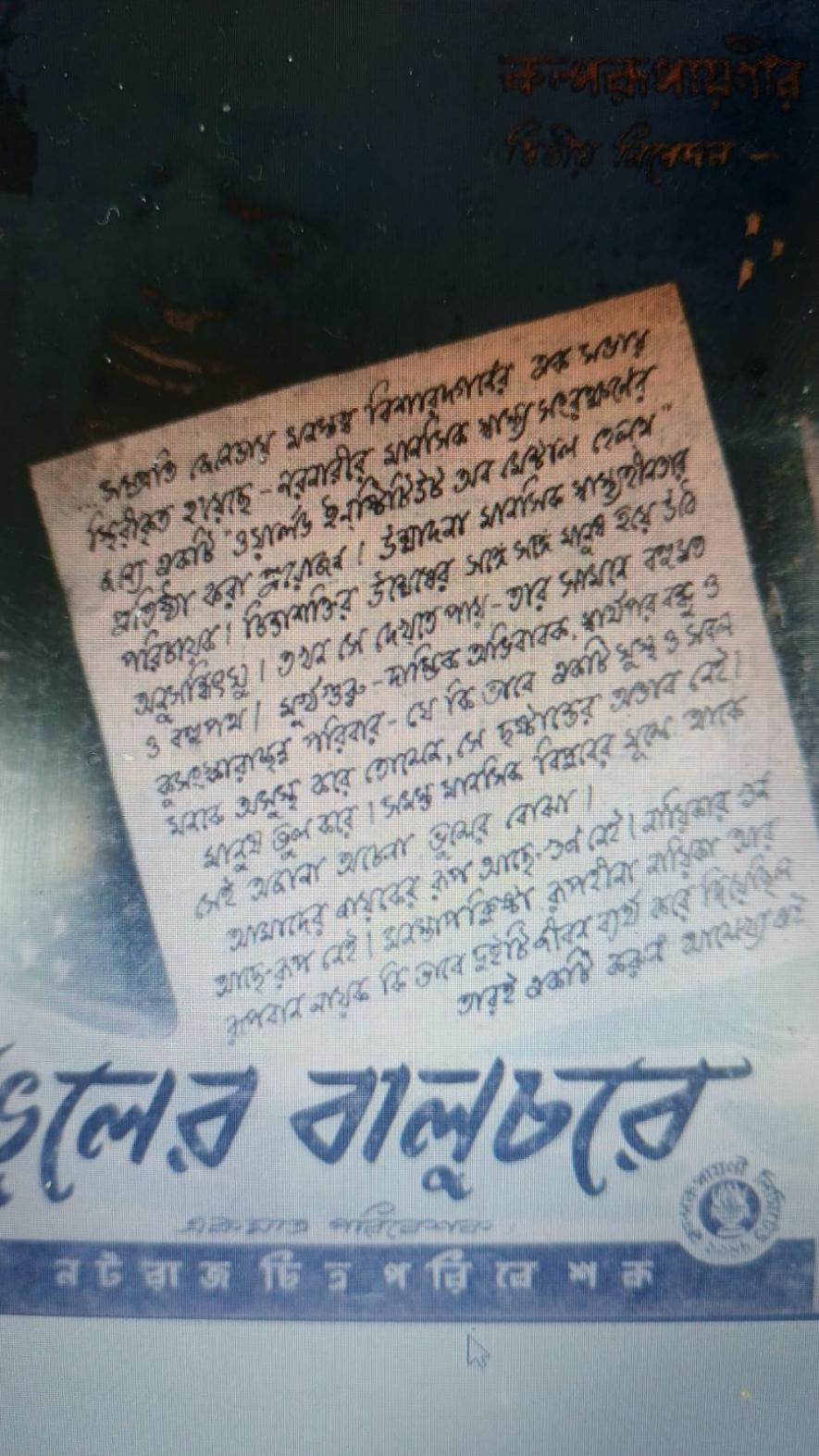
The poster of Jaladhar Chatterjee directed ahead of time film on mental health -- Bhuler Baluchare.
The other plays by Jaladhar performed at Star Theatre, Minerva Theatre, Rangmahal, and Natyabharati over the years include Aktara (a one-stringed instrument, symbol of folk music and simplicity), Sinthir Sindur (vermilion of the parting, a symbol of marriage and widowhood), Rangarakhi, Rather Thakur, and many others, several of which are now accessible through the online Bengali library Granthagara. His complete works, running to at least 21 documented items in the Granthagara archive, represent an output of sustained creative energy across several decades.
The Constellation of Performers
Jaladhar Chatterjee's plays were brought to life by the greatest performers of Bengali commercial stage. The three names that recur most prominently are Durgadas Banerjee, Shishir Kumar Bhaduri, and Ahindra Choudhury.
Shishir Kumar Bhaduri (1889–1959), reverently called Natyacharya (Teacher of Drama) and widely recognised as the pioneer of modern Bengali theatre, had brought realism and naturalism to a stage previously dominated by stylised declamation. His training as an English professor gave him an unusual analytical perspective on dramatic structure, and his insistence on psychological plausibility in character represented a genuine revolution in Indian theatre.
It was Bhaduri who, in 1930–31, took his production of Sita to New York, where it performed seven times at the Vanderbilt Theatre on Broadway — one of the earliest international showcases of Indian theatrical art. That such a figure should direct a film adaptation of Jaladhar's Reetimoto Natok speaks of the playwright’s standing within the elite of Bengali theatre.
Ahindra Choudhury (1896–1974), who bore the honorary title Natasurya — 'Sun of Actors' — was another towering presence in the world Jaladhar's plays inhabited. He won the Sangeet Natak Akademi Award in 1958 and the Padma Shri in 1963, and his final stage performance was in the title role of Shahjahan at Minerva Theatre on September 11, 1957. He appears in the cast of Abatar and the histories of Natyabharati note his centrality to that theatre company's fortunes.
Songs That Outlived the Stage
If Jaladhar Chatterjee's plays have passed into relative obscurity, the songs he wrote for those have been far more durable. Three compositions in particular have been sung across generations.
The most widely known of these is Swapan jodi madhur emon, jagio na amai jagio na ('If the dream is so sweet, do not wake me, do not wake me.) The song has that quality of great Bengali lyric poetry: a metaphysical image rendered with such simplicity that it seems to have always existed. It was first sung by Krishna Chandra Dey (1893–1962), known universally as K.C. Dey, the blind singer-actor-composer who, despite losing his eyesight at the age of 13, became one of the most distinctive voices of the acoustic and early talkie era in Indian music. Dey worked for various theatre groups before joining New Theatre in Kolkata, recording approximately 600 songs in multiple languages. He was the uncle and first music teacher of legendary singer Manna Dey. The songs then passed on to Manna Dey (Prabodh Chandra Dey (1919–2013), who was born in Calcutta on May 1, 1919, and had over five-decade career, recording some 3,500 songs. He became one of the most revered playback singers in Indian cinema and was awarded the Dadasaheb Phalke Award in 2007.
That Jaladhar's song was considered worthy of Manna Dey's voice is a measure of its lyrical stature. In later years, the song was taken up by Anup Ghoshal (1945–2023), who gave it classical refinement and emotional restraint of a voice steeped in Nazrulgeeti, Rabindra Sangeet, and Hindustani classical music. Ghoshal, who won the National Film Award for Best Male Playback Singer in 1981 for his work in Satyajit Ray's Hirak Rajar Deshe, is known to Hindi audiences for the haunting male version of Tujhse Naraz Nahin Zindagi from the 1983 film Masoom. He held a doctorate from Rabindra Bharati University with a thesis on Nazrulgeeti.
Jaladhar’s second song, Amar adhar ghorer alo, sokhi jwalo (Light of my dark house, friend, light it') speaks of spiritual longing rendered in deeply intimate terms. Sung by Anup Ghoshal, it belongs to the devotional-mystical strand of Bengali poetry that draws on the imagery of inner darkness and the divine light that might illuminate it.
The third, and perhaps the most emotionally charged in the context of Jaladhar's biography, is Amar kabita haraye felechi ('I have lost my poems.') This song was written near the end of Jaladhar's life, and carries within it the entire weight of what he had endured: the death of his daughter, the loss of his granddaughter, the slow dismemberment of everything he had built. It has been sung by Anup Ghoshal and has been used in numerous theatrical productions. It is the song of a man who knows what it means to have created beauty and then to have watched the world take it from him.
Family, Tragedy, and Final Years
The private life of Jaladhar Chatterjee moves from prosperity to grief. He had a daughter named Seema, whom he trained as a writer, a singer, and in the martial arts traditions of lathikhela (staff fighting) and chorakhela (another indigenous physical art form), suggesting that his feminism was not merely rhetorical but was enacted in the actual cultivation of his daughter's capacity for strength, independence, and self-expression.
In 1946, the Great Calcutta Killings happened. The violence and killings in four days of rioting and the psychological shock was not limited to those who suffered directly. Seema witnessed the bloodshed. Jaladhar later described her death as mental shock in the aftermath of the killings, the aftershock of witnessing the violence, which underscores how the communal catastrophe destroyed not only those directly in its path but also those caught in its psychological wake. Her death was untimely, robbing Jaladhar of a daughter he had raised much love and care.
Following Seema's death, her daughter Kabita, Jaladhar's granddaughter, and perhaps his last remaining thread of continuity, was taken away by her father to his own household, leaving Jaladhar's home in Cornwallis Street bereft of the child. It was from this profound loneliness, this stripping away of everything intimate, that he wrote Amar Kabita Haraye Felechi. The title was a statement of biographical fact.
Jaladhar died in 1964, in that same house on Cornwallis Street, in the heart of Calcutta's old north. His death came in the same year as that of Premankur Atorthy, the director who had filmed his Abatar — as if an entire generation of the Bengali theatrical world was passing together.
Legacy and the Question of Memory
How does one assess a figure who was, by the testimony of those who knew his era, the doyen of commercial Bengali theatre in the pre- and post-Independence period, and yet who today commands no Wikipedia entry in English, no standard biography in print, and whose name is familiar primarily to those with specialist knowledge of Bengali theatrical history?
Part of the answer lies in the structural conditions of cultural memory. Bengali commercial theatre from the first half of the 20th century is largely undocumented. The plays were performed, sometimes for years, but were rarely preserved as recordings. The printed texts survived in small editions, accessible now primarily through archival resources, such as the Granthagara digital library, which preserves at least 21 of Jaladhar's published works. The reviews perished in the newspapers of the day. The audience grew old and died. The theatres themselves burned, closed, were sold, or were converted to cinemas.
Part of the answer also lies in the ideological history of Bengali theatre memory. IPTA, founded in 1943, with its roster of celebrated names, including Bijon Bhattacharya, Shambhu Mitra, Ritwik Ghatak, and Utpal Dutt, became the dominant narrative of progressive Bengali theatre in the post-Independence period.
The cultural left, which wrote most of the histories, naturally centred its own institutional genealogy. Jaladhar, who had been doing progressive work in commercial theatre before IPTA existed, working outside the Left's organisational framework and in the spaces of commercial production rather than in the politically self-conscious group-theatre world, fell between the categories.
Yet the evidence of his significance is abundant. The greatest performers of the age — Shishir Kumar Bhaduri, Durgadas Banerjee, Ahindra Choudhury — performed his plays. The finest filmmakers of the era — Premankur Atorthy, Shishir Bhaduri himself — adapted his texts. Three of his songs travelled across three generations of the greatest Bengali and Indian singers, carried in the voices of K.C. Dey, Manna Dey, and Anup Ghoshal. His plays ran for years. He received formal honours — the Golden Pen and Inkstand — that the theatrical establishment of his time reserved for those it considered genuinely great.
He wrote about caste discrimination when the commercial theatre wrote about gods. He wrote about women's dignity when the stage offered women primarily as objects of sentiment. He wrote a play appealing to stop communal bloodshed when Calcutta was burning. He made a film about mental health. He trained his daughter in martial arts. These are not the acts of a conventional man or a conventional playwright.
The Lost Poems Found
There is a particular poignancy to the image of Jaladhar Chatterjee in his final years — the old man in the Cornwallis Street house, his daughter dead, his granddaughter gone, his world dismantled. He had written plays for 40 years. He had been celebrated across the stages of Calcutta. And then, in the aftermath of violence and personal loss, he wrote his last song: I have lost my poems.
And yet his poems are not lost. They are preserved in the voices of singers. They were printed and reprinted and now digitised. They were sung on stages across Bengal for decades after his death.
Scholars of Bengali theatre, of early Indian cinema, and of the social and cultural history of the sub-continent need to give Jaladhar Chatterjee the critical attention he deserves. The materials exist — in Granthagara -- in the archives of Calcutta's theatre societies, in the IMDb records of the films derived from his plays, in the histories of the performers who brought his work to life. What is needed is the will to look, and the recognition that the progressive tradition of Bengali culture did not begin with the ideologues of 1943 but extends further back — to a playwright from Jessore who, working in the marketplace of commercial theatre, chose again and again to tell his audiences the truth about the world they lived in.
Get the latest reports & analysis with people's perspective on Protests, movements & deep analytical videos, discussions of the current affairs in your Telegram app. Subscribe to NewsClick's Telegram channel & get Real-Time updates on stories, as they get published on our website.