






Even One Daily Drink Raises Cancer Risk, Says Study
Graphic Credit: Rajeev Choudhury
Even a single daily drink of alcohol—long considered harmless by many—can significantly raise the risk of oral cancer in India, particularly when combined with chewing tobacco, according to a large multicentric study published in BMJ Global Health. The findings challenge deeply rooted social beliefs about “moderate” drinking and carry serious implications for public health policy in a country already facing one of the world’s highest oral cancer burdens.
What the Study Found, and Why it Matters
The researchers analysed 1,803 patients with confirmed buccal mucosal cancer—cancer of the inner cheek lining—and compared them with 1,903 people without the disease across five Indian centres between 2010 and 2021. The researchers took a close look at drinking and smoking habits, including the use of globally named drinks and spirits made in this country that are popular in rural areas.
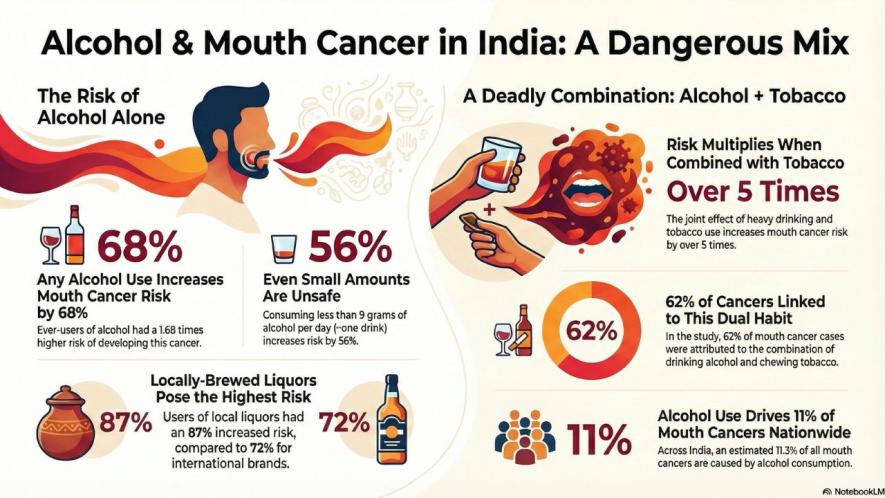
The results were stark. Alcohol drinkers had a 68% higher risk of buccal mucosa cancer compared with non-drinkers. Even consuming about 9 grams of alcohol per day—roughly one standard drink—was associated with nearly a 50% rise in risk. For those who mainly consumed locally produced alcohol, the risk rose further, to 87%.
The danger multiplied dramatically when alcohol was combined with chewing tobacco. The study estimated that this interaction alone accounts for about 62% of all buccal mucosa cancer cases in India.
India records an estimated 143,759 new oral cancer cases and around 80,000 deaths each year, making it the second most common cancer in the country. Less than half of patients survive beyond five years. Alarmingly, almost half of the cases analysed were among people aged 25 to 45, underscoring the disease’s growing impact on the working-age population.
How Alcohol and Tobacco Work Together
Scientists explain that alcohol increases the permeability of the mouth’s lining, allowing cancer-causing chemicals from tobacco to penetrate more deeply into cells. Dr Bibhuti Bhushan Barthakur, Director of Dr Bhubaneswar Barooah Cancer Institute, Guwahati, unit of Tata Memorial Centre under the Department of Atomic Energy, Govt of India, says this interaction is far more dangerous than most people realise.
“The essence is to understand that alcohol and tobacco are inherent risks, and the combined effects are more than additive. These risks may go beyond what can be mathematically quantified – some people may be affected by even occasional use,” he explains.
Alcohol also acts as a solvent, carrying harmful substances into body tissues. “Alcohol serves as a solvent to several cancer-causing chemicals and transports them into organs and ultimately the cells of the person,” Dr Barthakur says, adding that “even though the person’s body ultimately inactivates and eliminates these compounds, some amount of injury will always be caused.”
Some of this damage can occur at the genetic level, triggering changes that may progress into cancer over time—even if the exposure was limited.
Why Local Liquor Poses Higher Risk
One of the study’s most concerning findings relates to locally brewed alcohol. These drinks often have very high and unpredictable alcohol content and may be contaminated with toxins, such as methanol and acetaldehyde due to poor manufacturing controls.
People who rely on such liquor are usually from rural or economically weaker communities. “People normally tend to believe that whatever is local and traditional is better. In reality, these are more prone to contamination due to lacunae in their manufacturing processes,” Dr Barthakur notes. “It also implies that the consumers, who are usually rural and lower economic strata, are at much higher risk.”
Prevalence, Survival and Socioeconomic Cost
Beyond its medical toll, oral cancer carries heavy social and economic consequences. Treatment often requires surgery, radiation and prolonged rehabilitation, leading to loss of income and long-term disability. Because the disease increasingly affects people in their prime working years, families can be pushed into financial distress, while productivity losses add to the national economic burden.
Regionally, alcohol is estimated to contribute to about 11.5% of buccal mucosa cancers nationwide, rising to around 14% in high-burden states, such as Assam, Meghalaya and Madhya Pradesh.
Is Prevention Messaging Failing?
Given that nearly two-thirds of cases are linked to combined alcohol and tobacco use, experts argue that current prevention strategies may be inadequate. “The ill effects of alcohol and tobacco are amplified when they are combined. This holds true for all sites like the oesophagus, stomach, pancreas, liver, etc., and is not limited to oral cancers alone,” Dr Barthakur says. “More importantly, it is also true for all other diseases related to tobacco, including heart disease.”
Early detection could save lives, as the mouth is easily visible. “Early oral lesions are easily identifiable by anyone, since the entire oral cavity can be seen in a mirror,” he explains. Yet many patients ignore early warning signs or continue substance use while waiting for a diagnosis—a habit Dr Barthakur strongly warns against.
“No amount of alcohol or tobacco is safe. It only depends on what their metabolites have triggered within the body and how that is going to manifest over time,” he says.
From ‘safe limits’ to continuous risk
The study’s central message is clear: there is no safe threshold. Risk begins with the first drink, especially when tobacco is involved. In India, where alcohol and smokeless tobacco are still widely used, the results indicate that public health information needs to be completely shifted to concentrate on the deadly combination of these habits instead of just one habit.
The writer is a Delhi-based freelancer who writes on health issues and medical discoveries.
Get the latest reports & analysis with people's perspective on Protests, movements & deep analytical videos, discussions of the current affairs in your Telegram app. Subscribe to NewsClick's Telegram channel & get Real-Time updates on stories, as they get published on our website.