





Delhi: Under Tin Roofs in 45°C, Slum Dwellers Await Relief
Credit: Shoaibur Rahman
New Delhi: The capital is in the grip of an extreme heatwave. “Delhi recorded maximum temperatures between 45°C and 47°C in the past 24 hours. Temperatures were marked above normal at several places across the city,” the India Meteorological Department (IMD) said in an official press release.
IMD has forecast that heat wave to severe heat wave conditions will continue over many pockets of Delhi NCR from May 20-26. Maximum temperatures are expected to stay between 45°C and 47°C through May 22.
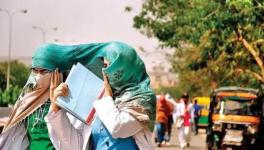
The department has advised people to avoid prolonged exposure to heat, wear lightweight and loose cotton clothing, and cover their heads when stepping outdoors, warning that infants, the elderly, and people with chronic illnesses face moderate to high health risk.
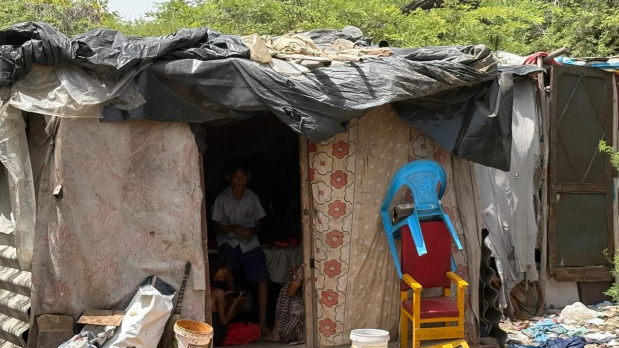
Official forecasts and advisories tell only part of the story. In the jhuggi-jhopdi clusters of Delhi, where nearly one-third of the city's population lives, the heat is not just a statistic. Even before noon, the inside of Zohra Begum's jhuggi in Noor Nagar is already suffocating. The roof is made of tin and plastic sheets. “The heat outside is 45 degrees Celsius. Inside, it feels worse like hell," she said.
Begum's 8-year-old girl has been feeling weak and dehydrated for days. "She keeps asking for water, but even though the water in our matka becomes warm by 10 a.m, I give her lemon water and pray,” she said.
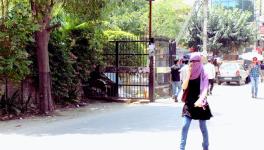
Under the scorching afternoon heat in Noor Nagar’s jhuggi-jhopdi cluster, residents gather beneath a tree shade as their makeshift homes become unbearably hot during the day. With tin roofs trapping heat and little ventilation inside the jhuggis, many people are forced to spend hours outdoors to escape extreme temperatures.
Despite claims in the Delhi Heat Action Plan that vulnerable settlements would be provided with cooling support, shaded relief spaces, drinking water access, and emergency heatwave assistance, residents say they continue to survive without basic facilities. Most homes in the cluster lack proper fans, coolers, and stable electricity, leaving families exposed to severe heat stress as temperatures in Delhi cross 45 degrees Celsius.
The Delhi Disaster Management Authority (DDMA) had identified slum clusters and low-income settlements as heatwave hotspot zones requiring urgent intervention. However, residents of Noor Nagar say the promised relief measures remain largely absent on the ground, forcing families to rely on roadside tree shade as their only protection from the unbearable heat.
Tin Roofs That Trap the Heat
Thirty-year-old Maya Devi sits under a tree outside her jhuggi. It is one of the few shaded spots in the Noor Nagar slum cluster. She originally came from Lucknow and now lives here with her husband and four children.
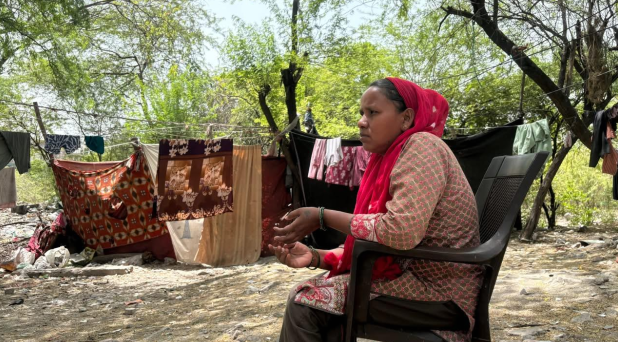
We are sleeping under a tin roof. There is only one fan in my home," she says. "During the daytime, because of the high temperature, we cannot stay inside. After finishing household work and cooking, I spend most of my time sitting under the shade of trees."
Her youngest son frequently loses consciousness and feels dehydrated due to the heat. When asked if she gives him ORS (Oral Rehydration Solution) recommended by doctors for dehydration, Maya shakes her head. "I give him sugarcane juice. I don't know what ORS is."
Delhi's slums are home to nearly one-third of the city's population. In clusters like Noor Nagar, Sanjay Colony,Jahangirpuri, Shastri Park, Wazirpur, and Vishwas Nagar, areas the Delhi government itself has identified as "thermal hotspots," temperatures inside jhuggis run 5 to 6 degrees hotter than the official weather reading. Tin and asbestos roofs absorb heat all through the day and release it at night, turning homes into ovens that offer no relief even after sunset.
No Water, No Toilets, No Relief
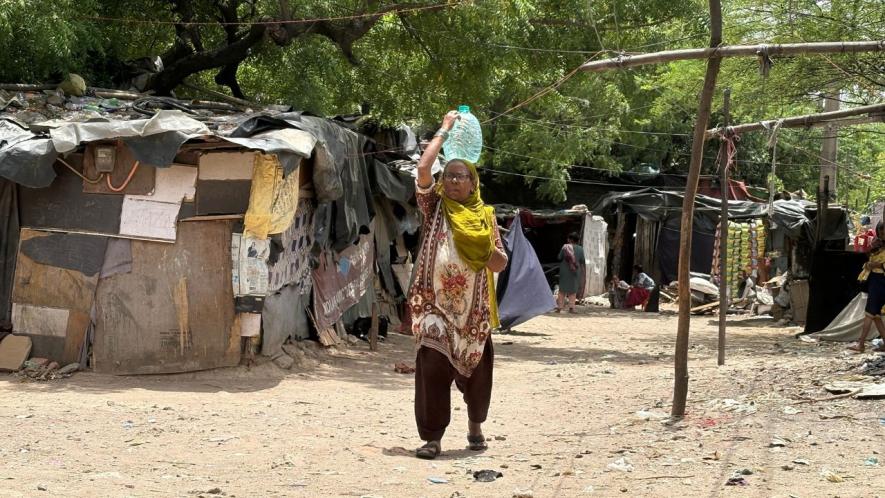
Basic needs are absent in Noor Nagar. Muskan Khatoon, around 48 to 50 years old, walks back through cluster lanes balancing a large water container on her head under the afternoon sun. She has walked far to fill it.
Credit: Shoaibur Rahman
"DDA does not provide proper drinking water facilities in our cluster area," she said, adding "In this extreme heat, we have to carry water from far away for our families or have to buy a 20-litre water can for Rs 30”.
There are no toilets in the settlement. Men and women alike must walk to open fields and forested areas for defecation. Bathing happens behind makeshift cloth-screens, sheets tied between trees. There is no running water.
"In this heat, old people, women, and children suffer the most," Muskan says. “The government is not making any arrangements for people like us during this extreme heatwave, here we are still struggling even for drinking water.”
Workers With No Choice
Mohammad Salim Ansari, 38, a water supplier in Noor Nagar’s jhuggi-jhopdi cluster, continues delivering water cans under the scorching afternoon sun around 12:30 p,m despite extreme heat conditions.
“The government says no work between 12 p.m and 3 p.m,” Ansari said, wiping sweat from his face while carrying a water container through the narrow lanes of the settlement. “But if I don’t work, who will feed my children? The owner of the water plant does not pay us for the hours we sit in the shade,” he adds.
Ram says the ongoing heatwave has made daily labour increasingly difficult, but economic pressure leaves workers with little choice. His wife, Rehana Perveen, who is eight months pregnant, has remained indoors for the past four days to avoid the intense heat.
“There is only one electric fan in our one-room jhuggi, and even that is unable to provide relief in this temperature,” he said.
The situation stands in contrast to the Delhi Heat Action Plan, under which authorities claimed that vulnerable populations and outdoor workers would be provided with heatwave awareness, cooling support, drinking water access, and emergency relief measures during extreme weather conditions.
Children: The Quietest Victims
Children are especially vulnerable. Their bodies take longer to adjust to rising heat. They dehydrate faster. And they often cannot describe what they are feeling until it becomes a medical emergency.
Nafis Alam, 10, is not attending school due to summer vacation but says "he is unable to study at home, His head keeps hurting due to extreme heat." His mother has no ORS at home. Their nearest government health centre is a 20-minute walk in the open sun.
A Plan on Paper, Absent on Ground
The Delhi Heat Action Plan identifies low-income settlements and slum clusters as major heatwave hotspot zones. It recommends temporary cooling centres, drinking water points, ORS distribution, heat-relief shelters, and emergency medical support for these areas. Delhi Chief Minister Rekha Gupta also announced a Heat Wave Action Plan 2026 that includes 13 mobile relief units, one per district, 3,000 water ATMs, and Quick Response Teams for high-risk zones.
On paper, it is one of the most detailed heat action plans the city has seen.
On the ground in Noor Nagar, residents say they have seen nothing.
"No one has come here with water or ORS or any kit," says Zohra Begum. "We only know it is a heatwave because our bodies are telling us,"she adds.
The ASHA worker assigned to Begum's area says she has received no extra supplies this season. The nearest cooling shelter is "somewhere near the school," she says, but she is not sure if it is open or who manages it.
Multiple government agencies, the MCD, Delhi Jal Board, the health department, and DDMA, are all responsible for different parts of the heat response. But in the city's most vulnerable pockets, coordination between them remains weak, and accountability remains absent.
According to IMD, the temperature will be the same till May 26. The tin roof will heat up again. The power will be cut again. And a mother will fan her sick child with cardboard again, waiting for a relief that has been announced, budgeted, and named, but has not arrived.
Heatwaves are still not recognised as a natural disaster in India, which means no slum dweller is legally entitled to disaster relief. Until that changes, slum dwellers will keep surviving summers with God’s blessings and government negligence.
The writer is a Delhi-based freelance journalist.
Get the latest reports & analysis with people's perspective on Protests, movements & deep analytical videos, discussions of the current affairs in your Telegram app. Subscribe to NewsClick's Telegram channel & get Real-Time updates on stories, as they get published on our website.