





The Contradiction in Trump’s Recent Visit to China
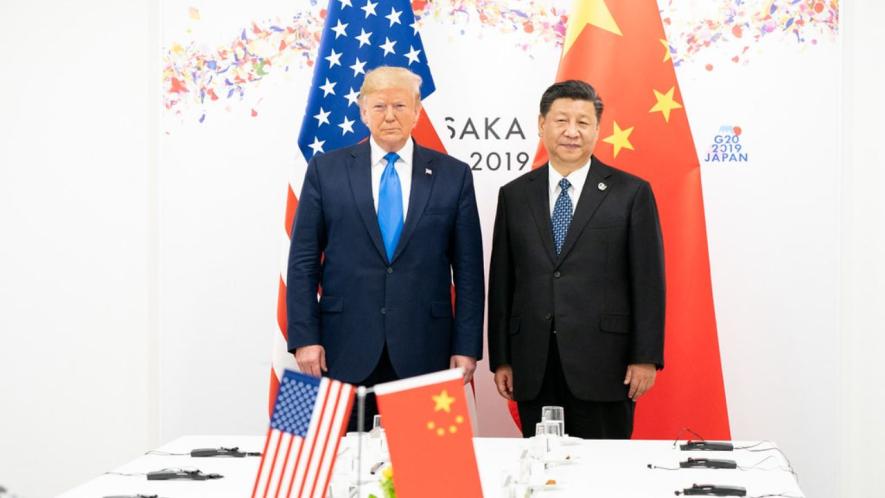
Image Courtesy: Flickr
During an examination invigilation, as students wrote in silence, news alerts about US President Donald Trump’s visit to Beijing kept appearing on our phones. Trump visited China on May 13, 14 and 15, 2026, marking a different shift in US foreign policy. For many, this was another diplomatic spectacle: the US President in China, with President Xi Jinping receiving him with ceremonial warmth, and both sides speaking the familiar language of trade, technology, Taiwan and strategic stability.
But for students of international relations, such moments rarely remain ordinary. They compel questions that lie beyond official statements and diplomatic choreography. What does it mean when the US President travels to the capital of the very power that American politics has spent years constructing as its principal adversary? What does it mean when a hegemon approaches its challenger not to dictate terms, but to negotiate, bargain and seek restraint? That, perhaps, is the real significance of Trump’s China visit.
The visit should not be viewed merely as another bilateral engagement. It marked a moment when the contradictions of American power became unusually visible. For nearly a decade, China has occupied the centre of American political anxieties. It has been blamed for factory closures, trade deficits, technological theft, supply chain dependence and the erosion of American industrial strength. In Washington’s political vocabulary, China is no longer simply another State; it has become the language through which America explains its own insecurity.
Trump understood this political language better than most. His rise depended heavily on transforming China into a symbol of American decline. To sound tough on Beijing became synonymous with patriotism. To promise punishment against China became a promise of national revival. Yet the same Trump eventually travelled to Beijing. And therein lies the contradiction.
The China that functions as an enemy in American electoral politics has simultaneously become indispensable in US foreign policy. Washington seeks Beijing’s cooperation on Iran and energy security. It wants stability in the Taiwan Strait. It seeks trade concessions, market access and continued economic engagement. It wishes to contain China’s technological rise without severing the economic interdependence that still binds the two powers together. This is not strategic clarity in the classical sense. It is the management of contradiction.
Theories of international relations provide partial explanations for this uneasy moment. Realism tells us that established powers fear rising challengers. Liberalism reminds us that economic interdependence makes rupture prohibitively costly. Power transition theory highlights the anxieties generated when a rising power approaches parity with a dominant one. Graham Allison’s much cited idea of the “Thucydides Trap” (mentioned by Xi Jinping) has become shorthand for the dangers embedded in US-China relations.
But Trump’s visit points to something deeper than textbook formulations. The central question is no longer merely whether China is rising. The more consequential question is whether the US can reconcile itself to a world in which China cannot be subordinated. So far, the answer remains uncertain.
The US is still the most powerful country in the international system. Its military reach, technological innovation, financial centrality and alliance structures remain unmatched. Yet the post-Cold War era of uncontested American authority has clearly narrowed. China has not replaced the US, but it has become powerful enough to make American primacy less assured than before.
That is what makes China uniquely difficult for Washington. It is not the Soviet Union, standing outside the capitalist global economy. It is not Iran, which can be isolated with manageable systemic consequences. Nor is it Russia, whose military reach far exceeds the scale of its economy. China is simultaneously a manufacturing giant, technological competitor, global market, creditor, military challenger and diplomatic actor. It is the rival from within the system itself.
This explains the contradictory character of American policy. Washington speaks of decoupling while American corporations continue to seek Chinese markets. It seeks to restrict Chinese technological expansion without collapsing global supply chains. It promises to defend Taiwan while attempting to avoid a war that would destabilise the world economy. It describes China as a strategic threat even as it seeks Beijing’s cooperation in managing crises beyond East Asia.
Trump’s Beijing visit exposed this duality with unusual clarity. The domestic Trump requires China as a political villain. The presidential Trump requires China as an interlocutor. The electoral Trump must promise confrontation. The geopolitical Trump must negotiate across the table from Xi Jinping.
That is why the visit carried an unmistakable sense of unease. It was neither reconciliation nor outright confrontation. Rather, it was the meeting point of rhetoric and geopolitical reality. Xi Jinping appeared to understand this perfectly. Beijing did not need to humiliate Trump; it merely needed to project parity. The image of a US President in Beijing discussing cooperation and stability already served Chinese interests. Trump sought transactions. Xi sought recognition. That distinction matters in international politics.
Recognition is not symbolic ornamentation; it is a form of power. A rising State becomes truly consequential when others are compelled to organise their behaviour around it. By that measure, China has already altered the structure of the international order. Taiwan remains the most dangerous test of this transformation. For Washington, Taiwan concerns credibility, deterrence and the balance of power in East Asia. For Beijing, it concerns sovereignty, reunification and regime legitimacy. Neither side can retreat easily because Taiwan is not merely a strategic dispute; it is deeply entangled with national identity.
Trump’s caution on Taiwan was, therefore, revealing. It did not reflect softness so much as recognition of danger. Confident hegemons announce red lines with certainty. Anxious hegemons begin calculating exits. Iran adds another layer to this evolving equation. If Washington requires Beijing’s assistance in managing tensions around Iran and the Strait of Hormuz, then China’s relevance is no longer confined to East Asia. It has become integral to global crisis management itself. This does not make China the new hegemon, but it does indicate that America can no longer organise major geopolitical crises alone.
There is, after all, a difference between power and hegemony. Power can coerce, sanction and punish. Hegemony performs something more ambitious: It makes leadership appear natural, legitimate and unavoidable.
The US still possesses immense power. What it increasingly lacks is the effortless ease of hegemony. That erosion explains much of the anxiety underlying the US’s China policy. China provides American decline with an external face. It allows Washington to attribute domestic crises to a foreign rival rather than confront the structural contradictions within American capitalism itself: deindustrialisation, inequality, financialisation, weakened labour protections, political polarisation and imperial overstretch.
China did not force American corporations to outsource production. It did not design America’s internal inequalities. It did not create the dysfunction of American politics. Yet in American political discourse, China absorbs these anxieties and becomes the external author of domestic decline. This is precisely why anti-China politics remains electorally effective. It simplifies decline. It transforms structural failures into foreign aggression. It offers a fragmented America a common adversary.
But the international system cannot be governed through campaign rhetoric. That, ultimately, is the lesson of Beijing. The same China denounced in American politics must still be consulted in global diplomacy. The same China accused of undermining American greatness must be engaged on trade, technology, Taiwan, Iran and energy security. The same China presented as a strategic threat remains indispensable to the management of the contemporary world order.
This is the deeper trap into which Trump walked. It is not merely the “Thucydides Trap”. It is a political trap of America’s own making: Washington has cultivated a domestic politics that requires China to remain an enemy even as the international system requires China to be treated as an indispensable actor.
Trump’s Beijing visit did not end US-China rivalry. What it revealed instead was the changing nature of that rivalry itself. America can mobilise voters by portraying China as the enemy of American greatness. It can impose tariffs, restrict technologies and strengthen alliances. But it can no longer manage the international system by pretending that China can simply be wished away. That is the hard truth revealed in Beijing.
The hegemon travelled to China because rivalry alone is no longer sufficient.
Dr Zahoor Ahmad Mir is an Assistant Professor of Political Science at Department of Social Science, Akal University, Talwandi Sabo. He can be reached at mirzahoor81.mz@gmail.com. Dr Firdoos Ahmad Reshi is an Assistant Professor of Political Science at Department of Political Science, Cluster University, Srinagar. He can be mailed at reshidous88@gmail.com . The views are personal.
Get the latest reports & analysis with people's perspective on Protests, movements & deep analytical videos, discussions of the current affairs in your Telegram app. Subscribe to NewsClick's Telegram channel & get Real-Time updates on stories, as they get published on our website.