





Why Iran War Matters for African Sovereignty, Stability
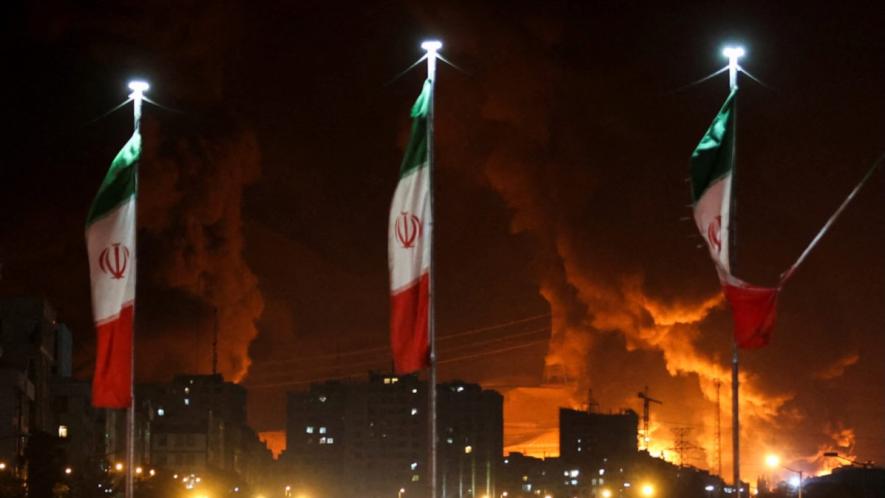
Iranian flags fly as fire and smoke from an Israeli attack on Sharan Oil depot rise. Photo: Council on Foreign Relations
The war on Iran by Israel and the United States has continued to unfold through attacks and bombings of a country that was already engaged in negotiations. While the conflict is centered in West Asia, its political and economic implications have now extended beyond the region.
However, beyond these immediate economic effects, such as the surge in oil prices, the war raises important questions for Africa, a continent that has historically been at the mercy of imperialism, about the fragility of sovereignty in a world where powerful states can impose sanctions, initiate military confrontations, and reshape geopolitical realities with limited accountability on the global stage just because you don’t get along.
If states such as Iran or Venezuela, countries with larger economies, strategic resources, and stronger military capacities than most African states, can be subjected to sanctions regimes, diplomatic isolation, or military confrontation, the vulnerability of African states has become even more evident. The situation is even more stark in the case of Cuba, where decades of sanctions, now reinforced by renewed threats of tighter restrictions, amount to a deliberate strategy of economic strangulation aimed at forcing the political submission of the country.
Analysts, social movements, and political actors across Africa are confronting the implications of the conflict. Will power be restrained by law, or will law be bent to legitimize power? A question asked by a coalition of progressive forces that include movements across Africa and the Caribbean. We are witnessing this aggression today in Venezuela, Iran, and many other places, but who will be next? As anti-war activists have long asserted, no country is safe if this kind of aggression is allowed to continue with impunity.
In dialogue with Peoples Dispatch, Mwaivu Kaluka, chairperson of the Communist Party Marxist – Kenya (CPM-K), points out that understanding the war is crucial for the global south and requires examining its deeper structural causes rather than the rhetoric often used to justify it.
“Our understanding of the war from the Global South must be based on the root cause of the war,” Kaluka explains. “This is not a war for bringing democracy in Iran; it is a war for the Iranian resources.”
He argues that the conflict cannot be separated from the historical struggle over control of Iran’s oil and strategic resources, particularly after the Iranian Revolution, which nationalized major industries and limited access for Western multinational corporations.
“The big oil multinationals have had a hard time expropriating Iranian oil and other resources since the Great Iranian Revolution of 1979,” he notes. “That revolution nationalized strategic industries to benefit the people of Iran.”
From this perspective, Kaluka argues that contemporary US foreign policy cannot be separated from the interests of powerful global financial and energy corporations. In his view, geopolitical decisions are often shaped by the priorities of these corporate actors. “The Trump administration is acting as a manager of the interests of these financial oligarchies,” he says.
The geopolitics of expansion
He also situates the conflict within a broader geopolitical struggle in West Asia, particularly the expansion of Israeli influence in the region.
“The second perspective is that of the Israel Zionist expansionist project,” he argues. “Israel has continued to annex areas from different countries to achieve the ‘Greater Israel’ dream.”
This process has included interventions and military operations across the region, including Gaza Strip, the West Bank, southern Lebanon, and the Golan Heights. Iran, he says, is targeted primarily because it represents a strategic obstacle to these ambitions.
Negotiations and the crisis of international agreements
The conflict has also raised questions about the credibility of diplomatic agreements and international institutions. Iran had previously signed the Joint Comprehensive Plan of Action nuclear agreement in 2015 with major global powers. However, the United States withdrew from the agreement in 2018, under the administration of Donald Trump, despite the deal being endorsed by United Nations Security Council Resolution 2231.
This decision shows a pattern in which negotiations are used as a strategic trick rather than genuine diplomacy.
“The US has always created a cycle where they pretend to negotiate, then bomb a country during negotiations,” he argues. “They demand unconditional surrender and later call for an ‘unconditional ceasefire’ without being accountable for their actions.”
He points to incidents where military escalation occurred even as diplomatic discussions were underway, twice now for Iran, such actions demonstrate a disregard for international law and peaceful diplomacy.
Sovereignty in a force-based international order
The deeper issue raised by the conflict, however, is the nature of sovereignty in the modern international system. According to Kaluka, the global order operates less as a system governed by law and more as one defined by power.
“We are operating in a system of a force-based international order and not a law-based international order,” he says. “The principles of equality and mutual cooperation are constantly undermined when powerful states impose their narrow interests on global institutions.”
In this context, Iran’s insistence on maintaining its nuclear program under the Treaty on the Non‑Proliferation of nuclear weapons is a matter of sovereign rights.
“Iran has the right to develop nuclear technology for peaceful purposes such as energy production, agriculture, and industrial development,” Kaluka states, noting that inspections by the International Atomic Energy Agency have repeatedly reported no evidence of a weapons program.
Why it matters for Africa
The CPM-K chairperson argues that the central lesson of the conflict lies in the broader struggle for sovereignty across the Global South.
“Any country that seeks sovereignty must understand the reality that it must defend that sovereignty,” he says. “Neglect this principle at your own peril.”
For African states, this argument resonates strongly in the context of the contemporary geopolitical shifts in the Sahel. Countries such as Burkina Faso, Mali, and Niger have increasingly pushed their political transformations as struggles against neocolonial influence, foreign military presence, and a fight for its sovereignty.
Speaking to Peoples Dispatch also, Mikaela Nhondo Erskog of Tricontinental: Institute for Social Research notes how African audiences interpret the conflict through their own historical experiences of intervention and struggles over sovereignty.
“From an African perspective, the Iran war is less about Iran itself and more about the structure of global power and the question of sovereignty,” she explains.
According to Mika, the conflict echoes earlier regime-change wars such as the Iraq War and the NATO intervention in Libya, which had profound consequences for the Global South.
“The current war is widely seen as part of that pattern,” she notes. “That is why many Global South governments have condemned the attacks as violations of international law and destabilizing precedents.”
She argues that two factors explain why the conflict resonates strongly across Africa.
“The first is that the war reinforces the lesson that military power is still used to discipline states that refuse to align with the dominant geopolitical order,” she says. “That is precisely the logic many Sahelian governments now challenge in their discourse on sovereignty.”
The second factor is economic vulnerability.
“For Africa, the immediate effects are economic,” she explains. “Rising oil prices and currency pressures hit import-dependent economies hard, while even oil-exporting countries gain little because they depend on imported refined fuel.”
The war is part of a broader geopolitical pattern in which powerful states seek to discipline countries that pursue independent development paths. What it also shows is how it disproportionately affects peripheral regions such as Africa, either through economic shocks or through the precedent it sets for international intervention.
She links these dynamics to a longer tradition of African anti-imperialist thought, referencing figures such as Kwame Nkrumah and Amílcar Cabral, who argued that imperialism operates not only through colonial rule but also through economic dependency, military pressure, and geopolitical fragmentation.
“In that sense, the Iran war reinforces debates already unfolding in Africa about non-alignment, BRICS expansion, and regional blocs seeking greater strategic autonomy.”
Ultimately, as Mika puts it, “The deeper issue is whether the international system will allow genuine sovereignty or continue to enforce hierarchy through force.” This remains a fundamental question and an urgent concern for Africa today.
Courtesy: Peoples Dispatch
Get the latest reports & analysis with people's perspective on Protests, movements & deep analytical videos, discussions of the current affairs in your Telegram app. Subscribe to NewsClick's Telegram channel & get Real-Time updates on stories, as they get published on our website.