





UGC, Caste and Limits of Representation
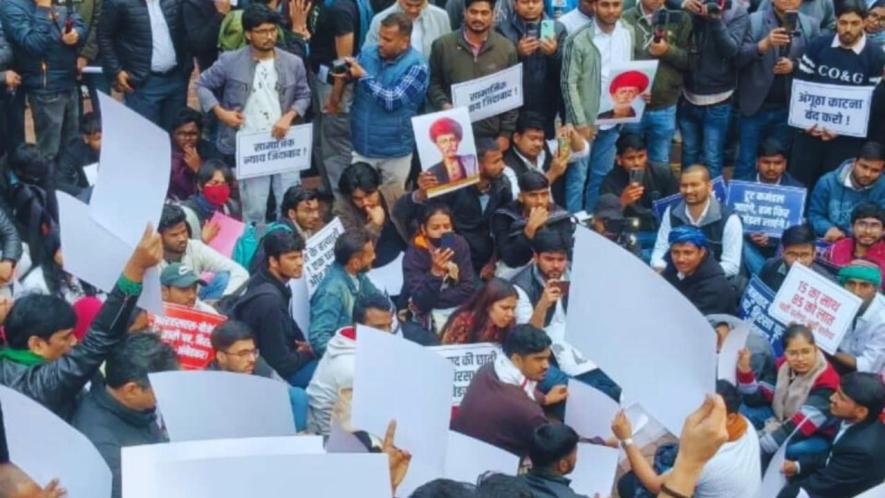
When Anjali, a research scholar and student activist, walked into the Maurice Nagar Police Station (in Delhi University) to lodge a complaint, she was not met with the protection of law. She was met with a mob gathered under the guise of protecting Ruchi Tiwari’s dignity. The veil quickly dropped when the crowd proceeded to threaten Anjali’s life and abuse her with sexual slurs. The same mob that had hours earlier attempted to disrupt the Pro-UGC protest by hurling casteist slurs was now chanting ‘Brahmanvad Zindabad’ outside the police station. Only days earlier, these very voices had denied the existence of casteism altogether.
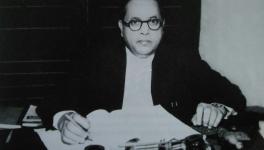
At first glance, this appears to be hypocrisy. One day they deny caste, the next day they celebrate Brahminical caste pride. One moment they demand justice for a woman, the next moment they abuse women. But this is not hypocrisy. What we’re witnessing is coherent and deliberate. It is structural and fits into longer historical pattern. It can be understood through Ambedkar’s counter-revolution by the forwards. Ambedkar argued that Indian history is not merely a story of gradual progress, but a battlefield between the idea of equality and desperate counter-mobilisation by forwards. Whenever caste hierarchy is challenged, dominant groups do not sit quietly. They regroup, reorganize and reassert themselves. Whenever status-quo appears to be disrupted, consolidation follows.
Anxiety Explained
What explains the anxiety we are witnessing on campus? Why do students who enjoy structural advantages, in form of caste, class & social capitals, feel the need to take to streets? Political scientist Ajay Gudavarthy describes such moments as expression of hurt-pride. The Structure, as I refer to it, suffers from an insecurity of losing the hold on political power and as a result, a sense of suffocation of losing their social power that they wielded so long. It has never needed to organize and protest. The system was built for them. It did not need concessions. It possessed land and cultural capital to define what’s merit and what’s not. But with the relative mobility of Dalits and the growing significance of marginalised communities in electoral politics, however modest it is, Savarnas perceive it as shift in political hierarchy. We saw it in the form of mobilization during anti-UGC protest against regulations that proposed wider caste-based discrimination redressal. In response, they ‘acted’ – threatening to break ties with their long-term political partnership with BJP. They raised anti-Modi slogans and organised aggressively. What we’re seeing is a political response to a perceived threat, the threat to lose control over resources and institutions.
The Unequal Campus
This anxiety does not exist in vacuum; it is etched onto the space of university. Campuses are often imagined as egalitarian spaces. That once one enters, the distinction of caste & class is dissolved and merit is the only identity that persists. However, the lived experience tells a different story. The experience of campus is never shared; it varies with one's social position. One doesn't need to have an enrollment in campus to understand that even friend circles and groupings are formed on the basis of caste and class. Social capital travels with surname and the one holding it often ignore it. Denial and assertion function together. Caste is invisible when it benefits them; it becomes a proud assertion when the Forwards feel challenged. It's not egalitarianism. It cannot be. Liberal democracy was never designed to accomplish this project. But that’s an argument for another time.
The Limits of Representation
Amid the chaos, the politics of representation has once again been contested. It is being argued and rightly so that we need more representation of Dalits and women in leadership roles. One cannot deny the necessity of representation. It of course matters. But representation alone cannot dismantle structural inequality. The limitation of this politics must be highlighted. The symbolic inclusion becomes the endpoint rather than the beginning and turns into what political theorist Ernesto Laclau refers to as ‘empty signifier’. Critical Theorist Nancy Fraser draws a distinction between recognition and redistribution. Recognition is concerned with being seen and validated while redistribution relates to material conditions. The two are connected but quite different. ‘The Structure’ is more than willing to recognize subalterns as long as it means avoiding demands of redistribution. Statues are being built, names are being changed, so the question of wealth accumulation along caste lines remains unattended.
Indian Character of Class and Caste
The emergence of identity politics in its current form has derailed the movement for reallocation of resources. The fight should have been for land redistribution; instead, it has become about holding sway over political constituencies. At the heart of this chaos is the power to hold resources. And that makes it ultimately a class war. But this class war has an Indian character. In India, as many argue, class and caste are not separate systems. The landowner is not just feudal-capitalist, he’s a Savarna Man. The sewage labourer is not just worker, she’s a Dalit Woman. One cannot redistribute wealth in India without, in Ambedkar’s terms, fixing Graded Inequality. And for that, annihilation of caste is needed. Annihilation of caste is not possible without wealth redistribution. Thus, what unfolds in university campuses is not a simple debate over emotions but a defence to preserve material inequality by the caste capitalists.
False Fraternity
Here enters the question of fraternity. The Savarna power cannot sustain itself through fragmentized caste alone. It requires numbers. This is where the Hindutva project comes into fold. Fraternity is invoked to create Hindu zealot mob. The mob is then asked to forget their caste differences since they have to fight a common enemy, which in the Indian context so far are Muslims. Also, ‘The Structure’ ensures that becoming part of the Hindutva mob remains the only way to gain recognition since a Dalit can only gain recognition by becoming a Hindu. But this recognition is conditional. The moment a Dalit demands land, the moment a woman demands dignity and liberty, the moment anyone tries to grow out of their assigned position within Hindutva, they are punished. Their loyalty is questioned. They become anti-national. Their character and merit are attacked.
Opportunity & The Fall of the Structure
The mobilization of the forwards should be seen as an opportunity to push the discourse to where it belongs, towards material basis of caste. We need to talk about wealth and land distribution; we need to talk about Inheritance taxation. One step at a time but we need to start. Representation and recognition, however necessary, will never be sufficient to improve social positions. They will never be sufficient to break ‘The Structure’. Ambedkar understood this. This is why he did not stop at demanding political representation for Dalits. Ambedkar’s Annihilation of Caste is the only solution for emancipation.
The means of production must go to where they belong. And we need to have a State, which works toward the anti-casteist socialist goal of annihilating caste. The state must work for the interests of the oppressed. But we cannot wait for the existing state to transform itself on its own. We need to create our own knowledge production – not symbolic statements, but robust institutions. Study circles that read Ambedkar alongside Marxism and Feminism. Alternative media that reports caste and gender-based violence. These should be the counter-hegemonic institutions that build foundation of political power capable of delivering material necessities to the people. Power that survives on humiliation fears equality. And anything that fears equality deserves to fall. It has to fall and it will fall - in our lifetime.
The writer is a student at Dept of Political Science, University of Delhi.
Get the latest reports & analysis with people's perspective on Protests, movements & deep analytical videos, discussions of the current affairs in your Telegram app. Subscribe to NewsClick's Telegram channel & get Real-Time updates on stories, as they get published on our website.