





Redefining Aravallis: Theft of the Commons
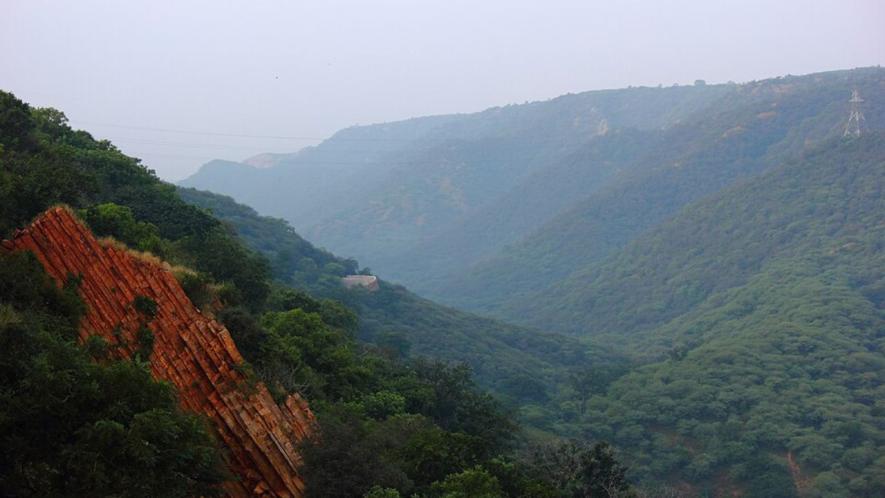
Aravalli Range in Rajasthan. Image Courtesy: Wikimedia Commons
The recent judicial executive move to impose a narrow, height-based definition of the Aravalli Range marks a troubling moment in India’s environmental governance. Traditionally, the Aravallis were understood as a continuous mountain system stretching over hundreds of kilometres from Delhi through Haryana and Rajasthan into Gujarat, across dozens of districts as an interconnected range that forms a natural barrier against desertification, supports rivers and watersheds, and sustains biodiversity and local livelihoods.
This ecological continuity reflected in historical geographic characterisations of the Aravalli Range, as a continuous fold mountain belt running from Delhi to Ahmedabad, has underpinned legal and conservation frameworks that treated the hills and their attendant ridges, foreshore landforms, and catchment areas as an indivisible whole. By recognising only landforms rising 100 metres or more above the surrounding terrain as “Aravalli hills,” the State has reduced one of the world’s oldest and most fragile ecological systems to a cartographic abstraction. What is projected as scientific clarity is, in effect, ecological amnesia, carrying grave consequences for environmental protection, federalism, and democratic accountability.
Opposition leaders have been unequivocal in flagging the dangers of this exercise. Congress leader and former Union Environment Minister Jairam Ramesh has described the redefinition as a bureaucratic sleight of hand that quietly erases large swathes of the Aravallis from legal protection without any transparent public debate on ecological costs. This arbitrary vertical threshold forgets that the Aravallis function as a continuous ecological system, where low-lying hills, forested ridges, scrublands, and catchment areas together sustain groundwater recharge, regulate dust and temperature, and support biodiversity across Rajasthan, Haryana, Delhi, and Gujarat.
By tying protection to height, the State effectively decouples ecology from law. This is precisely what environmentalists and Opposition voices warn against. Former Rajasthan Chief Minister Ashok Gehlot has pointed out that the move opens the door to renewed mining and real-estate pressures in precisely those zones that have historically borne the brunt of ecological destruction. These are areas that may not tower dramatically above the landscape but are indispensable to the integrity of the range. To exclude them is to hollow out protection while claiming compliance.
Mining Contracts and Political Economy of Redefinition
The redefinition cannot be understood outside the political economy of mining contracts. The Aravallis are mined not for strategic minerals but for quartzite, stone, sand, aggregates, and limestone, the raw materials of highways, flyovers, luxury housing, and urban infrastructure. These are low-value minerals extracted in high volumes, classified as “minor minerals,” and, therefore, governed by weaker regulatory scrutiny. Redrawing the legal boundary of what constitutes the Aravallis directly affects which parcels of land can be leased, auctioned, or diverted with ease.
This is where the government’s clarification assumes significance. While asserting that the new definition applies only to mining, and reiterating that mining is prohibited in the NCR (National Capital Region), the Union Environment Minister has simultaneously made it clear that restrictions will not apply to the mining of “critical, strategic, and atomic minerals” listed under the First and Seventh Schedules of the Mining and Minerals (Development and Regulation) Act, 1957.
The technical committee’s report goes further, recording the Rajasthan government’s assertion that the Aravallis contain deep-seated minerals falling under these schedules. In effect, while public discussion is steered toward minor minerals, the legal framework deliberately keeps the door open for extraction that can be justified as strategically or economically important.
The report itself acknowledges that beneath the surface, the Aravalli Range holds substantial mineral wealth, including marble, granite, mica, and other minerals that have historically fuelled construction and extraction across the region. This acknowledgement is wrapped in familiar language about balancing development and conservation. Yet, the exemptions embedded in the framework tell a more revealing story.
By recommending that mining restrictions “need not apply” to critical, strategic, and atomic minerals on grounds of defence and national security, the policy regime creates a hierarchy of extraction, where ecological protection is no longer a principle but a conditional privilege.
Environmentalists have, therefore, warned that the redefinition functions less as a safeguard than as an open-ended licence. As forest analyst Chetan Agarwal has pointed out, the combined effect of the new definition and the statutory exemptions is that mining for critical minerals would be permissible both in areas above 100 metres that are legally recognised as Aravallis and in areas below 100 metres that are legally rendered non-Aravalli hills. Whether one adopts the Forest Survey of India’s slope-based criteria or the Ministry’s height-based definition, future mining is not ruled out. At best, the framework promises uniform scrutiny. It does not promise ecological restraint.
Seen this way, the redefinition is not about scientific precision. It is about regulatory reordering. It preserves flexibility for mining interests under the shifting banners of development, growth, and national security, while steadily shrinking the space of unconditional ecological protection. What is being stabilised is not conservation, but the State’s discretion to extract, leaving the ecological integrity of the Aravallis to be negotiated, diluted, and overridden as required.
Once hills and ridges fall outside the formal definition, they become administratively invisible as ecologically protected spaces and legally legible as extractable real estate. In this sense, the redefinition does not curb mining; it reorganises mining opportunities. It converts contested landscapes into contract-friendly terrain. The redefinition legalises vulnerability.
Critiques insist that the issue is not scientific disagreement but state-enabled extraction. The language of “uniform definitions” masks a deeper redistribution of ecological risk from corporations and contractors to landscapes and communities that lack political power.
Sonbhadra is another case in the point, it shows where this logic ultimately leads. Often described as the energy capital of North India, Sonbhadra is rich in coal and dotted with thermal power plants that supply electricity to distant cities and industrial hubs. It is also one of the starkest examples of how State greed, legitimised through development discourse, devastates nature and people alike.
Decades of coal mining, fly ash dumping, forest clearance, and thermal pollution have left Sonbhadra environmentally scarred and socially impoverished. Adivasi and forest-dependent communities have been repeatedly displaced, their land acquired in the name of national interest, their water poisoned, and their livelihoods eroded. Despite fuelling urban growth elsewhere, Sonbhadra itself remains marked by poverty, poor health indicators, and ecological ruin.
Sonbhadra is not an aberration. It is a preview. It demonstrates how resource-rich regions are turned into sacrifice zones, where nature is stripped, communities are marginalised, and the benefits of extraction flow outward. The same logic now looms over the Aravallis, albeit through quieter legal instruments rather than overt dispossession.
Natural Justice, Commons, and Question of Who Pays
What is strikingly absent from the redefinition of the Aravallis, and from extractive governance more broadly, is any serious engagement with the law of natural justice. At its most elementary level, natural justice rests on the principles of fairness and the right to be heard. Yet in the appropriation of natural resources and common-pool resources (CPRs), these principles are routinely violated. Decisions that reshape landscapes, livelihoods, and ecological futures are taken without involving and without a concern towards communities who live with their immediate consequences.
Read Also: Halt Wanton Degradation of Aravallis
Hills, forests, grazing lands, water bodies, and mineral-bearing tracts are not inert assets waiting to be monetised. For local communities, pastoralists in the Aravallis, adivasis in Sonbhadra, forest dwellers and small cultivators across extractive belts, they constitute shared ecological commons, governed by customary use, collective knowledge, and intergenerational dependence. When the State redraws ecological boundaries, dilutes protections, or facilitates mining through redefinition and reclassification, it does so by dispossessing those most dependent on these resources, often without meaningful consultation, consent, or remedy.
This is distributive injustice. The benefits of extraction, mining contracts, construction material, electricity, urban infrastructure, flow upwards and outwards to corporations, contractors, and distant cities. The costs, displacement, loss of livelihoods, groundwater depletion, toxic air and water, long-term health damage, are localised and borne by communities with the least political power. Those who profit from extraction are insulated from its harms; those who suffer its effects are excluded from decision-making. Such an asymmetry violates the moral core of natural justice: no group should be made to bear burdens from which others reap gains without accountability or participation.
Sonbhadra offers a grim illustration of where this logic leads. Coal and power extracted in the name of national development have left behind ecological ruin, chronic poverty, and dispossessed communities. The Aravallis now risk being drawn into the same trajectory, less dramatically, perhaps, but no less decisively, through a legal sleight that converts ecological commons into contract-ready terrain. What is at stake is not simply environmental damage, but the erosion of natural rights: the right of communities to land, water, livelihood, and a sustainable future.
Environmental degradation also violates an often-overlooked dimension of natural justice, the obligation to do no irreversible harm. When ecosystems are destroyed in ways that foreclose future options, the injury extends beyond the present generation. It robs communities of resilience, adaptability, and dignity, while accountability for such harm remains diffuse or absent. Growth achieved by externalising damage onto the poor and the peripheral cannot claim legitimacy, however technically legal it may appear.
Shirin Akhter is Associate Professor at Zakir Husain Delhi College, University of Delhi. The views are personal.
Get the latest reports & analysis with people's perspective on Protests, movements & deep analytical videos, discussions of the current affairs in your Telegram app. Subscribe to NewsClick's Telegram channel & get Real-Time updates on stories, as they get published on our website.