





PHOTO ESSAY: Monuments Under Siege
A monument does not fall all at once.
It falls in increments in a politician's speech, in a budget cut, in a court petition, in a whitewash. It falls when someone decides it represents the wrong history, worships the wrong god, was built by the wrong dynasty, belongs to the wrong people. It falls when a corporation puts its name above the entrance gate. It falls when the entry fee goes up and the street vendor outside is told to move along. It falls, most finally, when the people who live beside it stop looking at it altogether.
This photo essay began not in the tourist footfall of a heritage site, but in a newspaper. In the years leading up to this project, India's monuments became battlegrounds in a way that had little to do with weather or neglect and everything to do with ideology. The Taj Mahal, one of the most recognisable structures on earth was called "a blot on Indian culture" by members of parliament and quietly removed from state tourism brochures. The Qutub Minar became the subject of legal petitions demanding that Hindu and Jain temples within its complex be "restored," its Islamic history reframed or written out. Monuments were renamed, their plaques altered, their contexts quietly shifted. None of this required a wrecking ball. It only required language, paperwork, and the slow machinery of institutional will.
What this series attempts is a visual argument about that process in which heritage is not simply neglected but actively contested, captured, commodified, rewritten, fenced off, and finally made invisible. Each photograph places a living person against a hand-drawn monument, and in that collision between the real and the rendered, it asks a question that cannot be answered by preservation law or cultural policy alone: who decides what deserves to survive?
The choice to use drawings rather than photographs of the monuments themselves is deliberate. A pencil drawing is contingent it exists because someone chose to make those marks, and it can be unmade just as easily. It has none of the apparent permanence of stone. And yet these monuments, which have stood for centuries, are being unmade right now, not by time but by human decision. The drawing makes that fragility legible. It says: this is not inevitable. This is a choice.
The seven images in this series trace an arc that is not random. It moves from erasure to capture to commodification to rewriting to exclusion to demolition to blindness—the full sequence of what happens to a monument when the society that holds it decides, consciously or not, that it is inconvenient. This is not a lament for a golden age of heritage stewardship that never existed. It is a reckoning with what is happening now, in the present tense, to structures that cannot speak in their own defence.
The Erasure
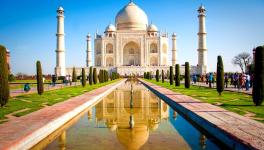
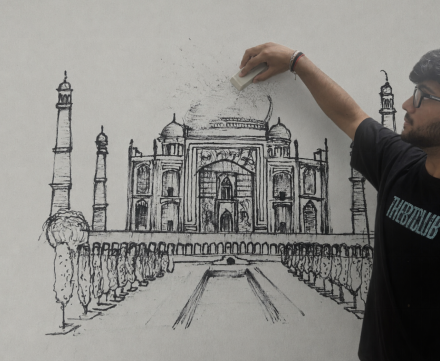
Taj Mahal, Agra: Deliberate Erasure of Inconvenient Heritage
The Taj Mahal has survived Mughal decline, colonial appropriation, and centuries of weather. What it has not survived, entirely, is the political climate of the last decade. When elected representatives call it "a blot on Indian culture," when it disappears from tourism brochures that have featured it for generations, when its Islamic origins become a liability in the national conversation something is being erased, even if no stone is touched.
The hand in this image holds not a hammer but an eraser. That distinction matters enormously. Erasure is not destruction it is revision. It suggests that the thing being erased was always optional, always provisional, never really ours. The dust rising from the dome is the dust of deliberate forgetting. The monument does not resist. It simply disappears, section by section, under the even, unhurried pressure of a decision that has already been made somewhere else in a speech, in a policy document, in the silence of an omission.
The Flag
Qutub Minar, Delhi: Ideological Capture
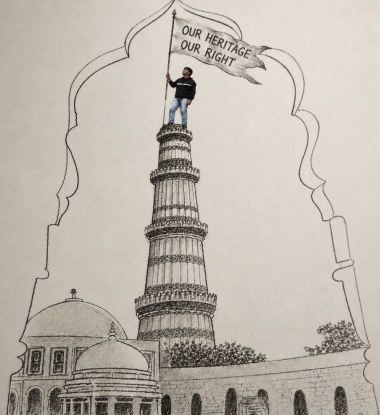
"OUR HERITAGE. OUR RIGHT." The flag says what the legal petitions, the court cases, and the protest marches have been saying for years. The Qutub Minar complex has been at the centre of demands to hold religious ceremonies within its precincts, to "restore" temples that petitioners claim were destroyed during its construction, to rename and reclaim it for a different historical narrative. A Delhi court heard arguments about this as recently as 2022. The monument has not changed. The battle over what it means has intensified enormously.
Flag-planting is the grammar of conquest. It says: I was here first, or I am here now, which amounts to the same claim. The figure in this image stands at the very top of the Qutub Minar, tiny against the scale of the structure, and yet the flag makes them large. This is the paradox of ideological capture the monument becomes bigger the more aggressively it is claimed, and smaller the more it is reduced to a single story. The Qutub Minar was built over centuries by multiple cultures and contains the evidence of that complexity in its very stones. The flag wants to simplify that. Simplification is its own kind of siege.
For Sale
India Gate, New Delhi: The Privatisation of Public Memory
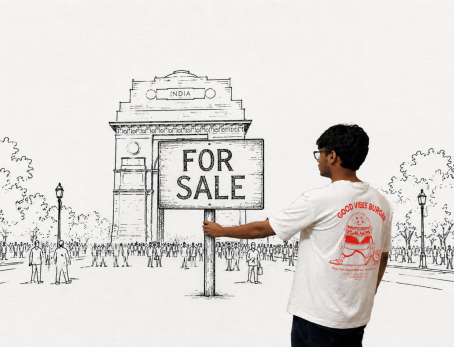
In 2021, the Indian government announced that several of India's most significant heritage sites would be "adopted" by private corporations under a monument mitra scheme their maintenance, branding, and visitor experience handed to companies in exchange for naming rights and commercial access. The policy was framed as pragmatic: the state cannot fund everything. But the logic it carries is more troubling than its administration. When a monument becomes an asset, it acquires terms and conditions. It acquires a stakeholder who is not the public.
India Gate carries the names of over 70,000 soldiers. It was built with the grief of a nation, paid for in lives, erected to be permanent and communal and irreducible. The "FOR SALE" sign does not introduce a new idea into this space. It names what has already happened. Around the figure in this image, hundreds of drawn people go about their life's picnics, photographs, evenings out unaware that the ground beneath the monument has shifted. Heritage has become inventory. The question the sign asks is simple and devastating: once it is sold, to whom does it belong?
The Whitewash
Red Fort, Delhi: Rewriting History Over the Top of Itself
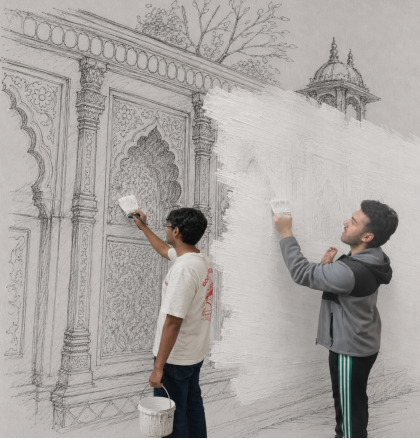
Across India in recent years, streets have been renamed, cities have been renamed, textbook chapters have been rewritten, plaques have been quietly altered. The surface of history is being repainted. Red Fort built by the Mughal emperor Shah Jahan, the same emperor who built the Taj Mahal has for decades been the site of India's Independence Day address. It is a monument whose political meaning has been actively renegotiated with every government that stands at its ramparts. The structure remains. The story told from it changes.
Two people in this image paint over the ornate Mughal carvings of Red Fort with broad, even strokes of white. They are not vandalising they are working. Their posture is calm, methodical, professional. This is what makes the image more unsettling than any act of graffiti: it has the quality of a sanctioned task. Whitewashing is not a crime of passion. It is administration. The carvings disappear, not into rubble, but into blankness a surface ready to be written on again, differently, by whoever holds the brush next.
The Vendor
Hawa Mahal, Jaipur: Exclusion Through Commercialisation
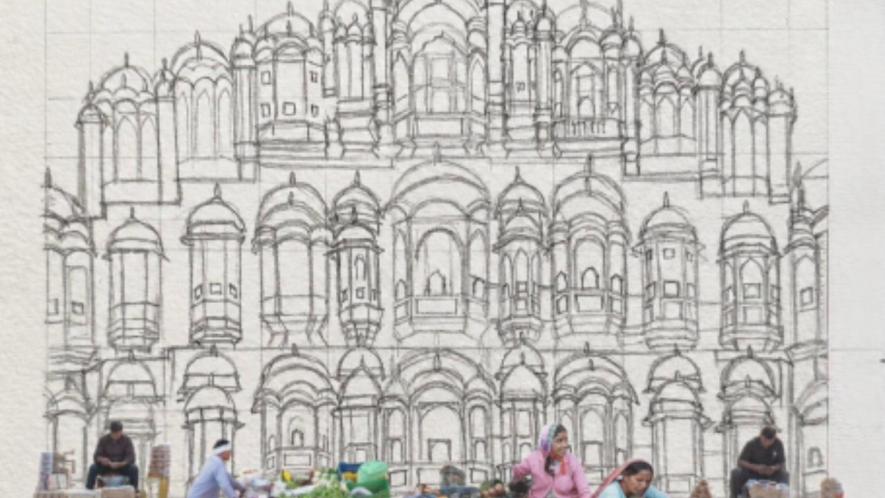
Heritage tourism in India is a multi-billion-rupee industry. Entry fees, ticketing infrastructure, curated visitor experiences, and corporate sponsorships have transformed the relationship between monuments and the people who live beside them. As the formal economy of heritage expands, it increasingly displaces the informal one the vendors, the hawkers, the daily earners whose lives have always been organised around these sites. Hawa Mahal was built in 1799 partly as a space for royal observation of public life. The street observed is now being priced out of its own surroundings.
Nobody in this image is looking at Hawa Mahal. The vendors are working; the buyers are buying; the carts are moving. This is not indifference in the tourist sense it is the indifference of people for whom this structure is not a destination but a backdrop, not a heritage site but a wall beside which they earn their living. The political charge in this image is not about those people. It is about the system that surrounds them—the one that will, eventually, clear this pavement, raise the entry fees, install the ticket barriers, and call it preservation. The most insidious form of exclusion is the kind that arrives dressed as care.
The Rope
Qutub Minar, Delhi: The Politics of Demolition
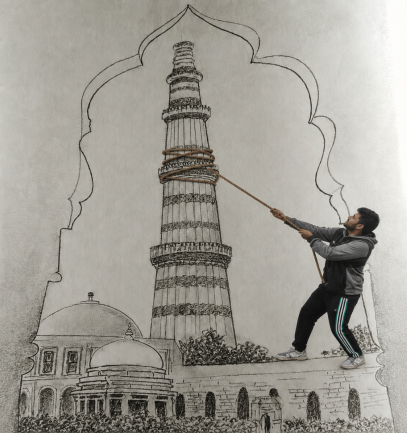
Across the world and within India, the question of which monuments deserve to stand has become one of the most contested in public life. Statues have been pulled down in Bristol and Richmond and Colombo. In India, demands to demolish or fundamentally alter structures associated with Mughal or colonial rule have grown louder and more formally organised. The Qutub Minar appears in this series a second time and its reappearance is intentional. In the earlier image, someone claimed it with a flag. Here, someone is trying to pull it down.
The rope coiled around the tower and pulled taut by a figure leaning back with full-body effort is not metaphor for a fringe position. It is a literal representation of a live political debate: whether monuments whose builders are now deemed oppressive or foreign should be permitted to continue standing. The Qutub Minar does not move in this image. But that is not reassurance it is suspense. The question the rope asks is not whether a single person can pull down nine centuries of stone. It is who, ultimately, has the authority to decide that it should come down. And whether that authority, once exercised, can be undone.
The Throne
Char Minar, Hyderabad:Collective Blindness as the Final Siege
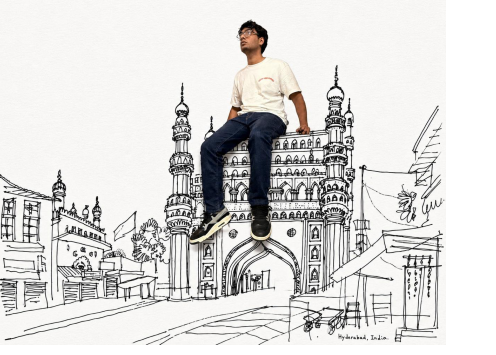
The essay ends not with demolition but with something quieter and in some ways more final. A person sits on top of Char Minar the 400-year-old monument at the heart of Hyderabad's old city with the ease of someone who has found a good seat. Legs dangling, gaze directed upward at nothing in particular. The full street scene of Hyderabad is drawn around them: the city that grew because of this monument, that organised itself around its four minarets, that has been shaped for four centuries by its presence. And the person on top of it is looking away.
This is the throne image and the throne, read politically, is not a symbol of love but of dominion. To sit on something is to declare it beneath you. To look away from it while sitting on it is to declare it irrelevant. This is the endpoint of the political arc this essay traces: not the flag-planter who at least acknowledges what they are claiming, not the rope-puller who at least engages with the structure they oppose but the person who has claimed the monument so completely that they no longer need to look at it. Collective blindness is not the absence of a siege. It is the siege's conclusion. The monument stands. But no one is watching over it anymore. That is how things are lost.
CONCLUSION
What these seven images collectively argue is that the greatest threat to India's built heritage is not time or weather or the indifference of tourists. It is the fully conscious, politically organised, institutionally enabled decision to treat monuments as contested ground as sites where history can be rewritten, ownership asserted, inconvenient pasts erased, and public goods converted into private or ideological assets.
The monuments in this series — the Taj Mahal, the Qutub Minar, India Gate, Red Fort, Hawa Mahal, and Char Minar were each built to outlast the circumstances of their creation. They were built in the knowledge that rulers fall, empires dissolve, and meanings change. What they were not built to survive is a moment in which the society that inherited them decided, systematically, that they were problems to be solved rather than truths to be held.
There is a version of this essay that ends with hopea call to action, a list of things that can be done. This is not that essay. What these images offer instead is clarity: a precise account of what is happening, who is doing it, and what it costs. The monuments are still standing. The question is not whether they can survive the forces arrayed against them. The question is whether we can.
A monument under siege does not ask to be saved. It asks to be seen.
Naamaan is pursuing Management Studies at Shiv Nadar University. This visual project has emerged out of a course on photographic image taught by Sreedeep Bhattacharya.
Get the latest reports & analysis with people's perspective on Protests, movements & deep analytical videos, discussions of the current affairs in your Telegram app. Subscribe to NewsClick's Telegram channel & get Real-Time updates on stories, as they get published on our website.