





Manipur: How a Village is Rebuilding its Rainforest Commons
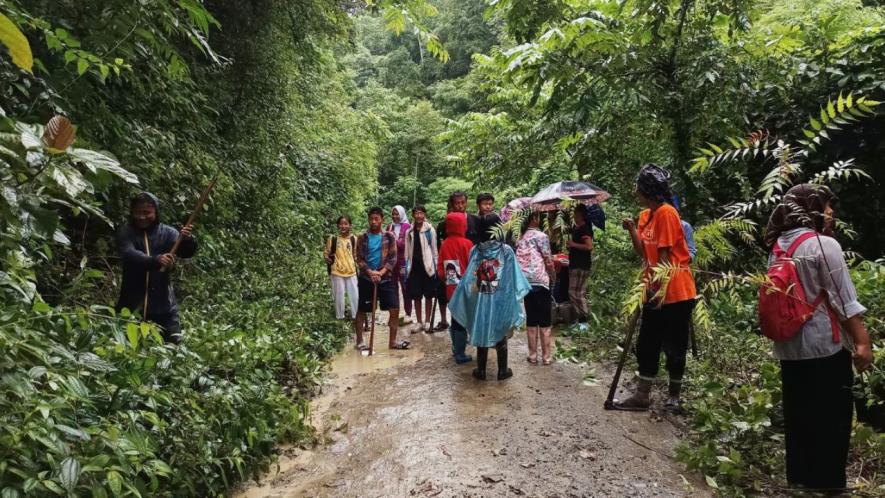
The Reforestation initiative saw participation from the youngest as well as the oldest members of the community (Photo - Worngachan A Shatsang, 101Reporters)
Ukhrul, Manipur: The Koirer hill range in Phalee village stands in stark contrast to the lush greenery around it. Its landscape is dotted with tree lines at the base and patches of shrubs higher up. From a distance, the mountain range appears almost anomalous: desert vegetation in the midst of a rainforest.
Upon closer examination, however, the foreboding hill reveals the long-lasting impacts of human pressure. Like most adjoining mountain ranges, Koirer was once a thriving rainforest. But years of deforestation and exploitative farming practices have reduced the hill to a barren wasteland.
“No vegetable grows well on the hill anymore,” remarked Shimreishang, a community member, as we drove towards the foot of the mountain.
A shift in cultivation
Phalee, a small village west of Ukhrul in Manipur, is perched at an elevation of 1,533 metres and covers an area of 17 sq. kilometres, most of which is commons. It lies within the Indo-Burma Biodiversity Hotspot, one of the richest biodiversity hotspots in the world.
For ages, the indigenous community of Phalee practised jhum cultivation alongside wet paddy cultivation. Jhum, or shifting cultivation, relied on the slash-and-burn of forest cover for farming but was carried out in a cyclical pattern of slashing, farming, fallowing and regeneration. As such, these practices, rooted in traditional wisdom, were largely eco-friendly and sustainable.
A considerable shift came in the 1970s when rapid population growth, coupled with timber extraction and deforestation for firewood, began depleting the forest cover of the commons in Phalee. This shift was marked by an incident in which a leopard entered a homestead, reflecting a case of human-wildlife conflict caused by habitat destruction and signalling early signs of environmental degradation.
Instead of allowing deforested areas to regenerate, commercial agricultural expansion of non-native crops and other illicit farming activities began rising in the early 2000s. As the fertility of the land declined year by year, chemical fertilisers were introduced in the farming areas, leading to land degradation and contamination of water sources.
The Global Forest Watch web tool shows that 159.6 hectares of tree cover were lost in this region in less than two decades, representing a significant 11.6% decline in the overall tree cover of the community commons.
Citizens, science and forest commons
Alarmed by this rapid loss of forest cover and the absence of baseline biodiversity documentation of the commons, a few like-minded members of the community started a citizen science documentation initiative in 2016. The Phalee Biodiversity Management Committee (Phalee BMC) was set up with a bio-cultural framework that placed community stewardship and indigenous knowledge at its core.
The BMC focused on documenting indigenous crops, traditional farming methods, seasonal calendars, and the conservation of medicinal plants and native fruit tree species. In 2019, this initiative was formalised into a community-based organisation called the Rainforest Biodiversity of Phalee.
“Our commons are endowed with rich biodiversity, and we have comprehensive traditional knowledge of this diversity, but lack documentation. It was imperative, thus, that we documented our diversity to know which species have potential, which species hold value and the work we must undertake to regenerate, restore and preserve the biodiversity of our commons,” says Dr Ngalengshim, one of the founding members of the Rainforest Biodiversity of Phalee.
In the years that have followed, the Rainforest Biodiversity of Phalee has documented over 4,000 observations through this citizen science initiative and curated them on its microsite within the India Biodiversity Portal.
Of these observations, around 700 species are research grade and have been scientifically validated and curated, and can be accessed through the Global Biodiversity Information Facility. A further 150 medicinal plants – including Himalayan Paris, mugwort, winged prickly ash and chameleon plant – were documented. The initiative also recorded 12 neglected and underutilised crop species such as job’s tears, millets and perilla, and 10 native wild fruit species including Nepali hog plum, wild persimmon, Indian olive and Himalayan apple.
From documentation to conservation and regeneration
Following the success of the documentation initiative, the Rainforest Biodiversity of Phalee began working on a 1.8-hectare commons area as a micro-reserve for conservation and long-term monitoring of medicinal plant populations, other native species and vegetation types.
The micro-reserve is located at the base of the degraded Koirer range, one of the most severely degraded commons in the village. In November 2022, the community was awarded a conservation and restoration grant by the United Nations Development Programme–North-East India Biocultural Initiative.
The grant helped the community set up two greenhouses to seed and nurture native plant and tree species. The greenhouses, each measuring 16 by 50 feet, were also set up on degraded land at the base of the Koirer range and produced more than 10,000 native plant saplings of about 65 species between 2023 and 2024.
Currently, more than 10,000 saplings of 15 species of native trees and fruit trees are being prepared in the nursery.
“I think I must have planted more than a hundred trees in the past few years. Most of them are fruiting trees because they look nice when they flower, and birds can eat the fruits too,” Shimreishang, a young member of the Rainforest Biodiversity of Phalee, says with a smile.
He serves as the caretaker of the greenhouse nursery and conducts routine checks on the saplings every week.
The trees he has planted constitute a small part of the thousands, approximately 6,000, of native trees that have been planted in the commons in and around Koirer by the community as part of forest restoration efforts.
These reforestation initiatives have been taken up by both the oldest and the youngest members of the community. Shrubs and grasses have also started reclaiming the once-denuded lands at Koirer, improving green cover, while saplings planted as part of the reforestation initiative have begun to grow.
Saplings of native plants and fruit trees have also been sold in thousands to neighbouring villages, generating income for maintaining the greenhouse nursery. Plans are also in place to establish a seed bank for preserving indigenous seed varieties.
The last hurdle
Despite these early successes, a major challenge remains. Conservation and restoration efforts are not yet an economically viable alternative to the exploitative farming practices that degraded Phalee’s commons in the first place.
In privately owned pockets of the village, some rogue community members continue illicit farming practices, particularly poppy cultivation.
To counter this, the organisation has stepped up efforts to support integrated kitchen gardens to strengthen household food security and generate income through the sale of excess produce. A weekly Wednesday market has also been introduced to provide farmers with direct market access.
But members of the Rainforest Biodiversity of Phalee are aware that the income generated from selling kitchen garden produce cannot match the profits from illicit farming activities.
“RBP’s is a small effort to provide community members with a choice to safeguard their commons. Sadly, changing the long-standing economic dependence of farmers on illegal cash crops is going to take a while,” says R Raman, one of the founding members of the organisation.
Nursing the nursery
Yet there are reasons for optimism. The community’s efforts to educate younger generations about conservation and restoration have begun to show results. Many young members of the community have taken the lead in biodiversity mapping and reforestation initiatives. Extensive fishing and hunting in reserve commons have also declined in recent years.
While the long-term impact of restoration efforts cannot yet be quantified, given how recent the initiative still is, deforestation and degradation of the commons have reduced considerably since the programme began.
In 2023, during the 29th Annual Conference of the Yale International Society of Tropical Foresters, Rainforest Biodiversity of Phalee was awarded the Innovation Prize for its efforts in documenting traditional knowledge and biodiversity for conservation.
Today, Phalee has more than 20 greenhouses of different sizes managed by self-help groups and farmers for cultivating vegetables, flowers and spices through the RBP project.
Even the youngest members of the community have begun to show interest in these efforts.
“Most school-going children know the local name, common name and scientific name of a number of trees and insects found in our commons by heart,” says Shimreishang, who himself belongs to the younger generation now taking forward the initiative.
The greenhouse he takes care of stands as a testament to how much effort the younger generation is putting in to restore their commons to the thriving rainforest it once was.
Worngachan A Shatsang is a freelance journalist and a member of 101Reporters, a pan-India network of grassroots reporters.
Get the latest reports & analysis with people's perspective on Protests, movements & deep analytical videos, discussions of the current affairs in your Telegram app. Subscribe to NewsClick's Telegram channel & get Real-Time updates on stories, as they get published on our website.