





India’s Solar Boom Has a Waste Problem
File Image
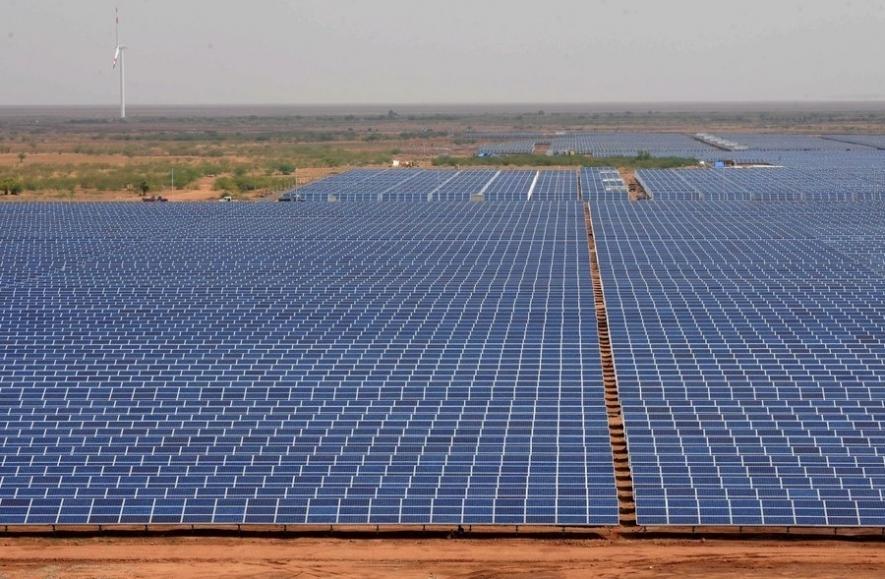
India’s solar revolution has been touted for over a decade as evidence that economic growth and climate action can go hand in hand. Every new solar park that is opened, every renewable energy target that is set, and every increase in installed capacity is cited as evidence of the country’s commitment to a low-carbon future. India has become one of the fastest-growing renewable energy markets in the world with over 100 GW of installed solar capacity and a high target of 500 GW non-fossil fuel capacity by 2030.
But underneath this success story is an uncomfortable reality that is hardly discussed in public. The same solar panels that are currently the face of India's clean energy transition will start entering the waste stream in unprecedented numbers in the next decade. The question that policymakers have largely ignored is: who will recycle millions of discarded solar panels? Not answering this question risks further entrenching the very environmental injustices that India’s green transition is trying to address.
Green Transition Faces End-of-Life Issue
Discussions on renewable energy in India are largely focused on installation targets, investments and carbon reduction. Policy debates still lack the full life cycle of renewable technologies. Solar panels won’t last forever. Most photovoltaic modules have an operational lifespan of around 25 to 30 years. However, rapid improvements in efficiency mean that many developers replace functioning panels much earlier to maximise electricity generation and profits. As a result, waste generation will most likely begin much sooner than expected.
According to the International Renewable Energy Agency (IRENA), global solar photovoltaic waste could reach nearly 78 million tonnes by 2050. India, as one of the world's largest solar markets, will play a significant role in this growing waste mountain. Yet there is little evidence that India's waste management infrastructure is ready for this challenge. Instead, the country's renewable energy policies are still focused on deployment and giving much less thought to what happens when these technologies have outlived their useful lives.
Solar panels not considered "clean" waste.
One of the biggest misunderstandings around solar energy is that solar panels are environmentally neutral throughout their lives. While photovoltaic modules provide electricity without pollutants, their disposal offers a far more difficult picture. Traditional solar panels are made from glass, aluminium, silicon, copper, polymers and small amounts of precious metals like silver. Older and thin-film technologies may also contain toxic chemicals, including lead, cadmium and selenium.
If panels are broken, dumped into landfills, or disassembled using dangerous practices, these harmful elements can contaminate soil and groundwater. Persons are also exposed to hazardous substances when handling is not done properly. India has already seen the consequences of poor management of electronic waste. Although the E-Waste (Management) Rules are in place, almost all electronic waste still flows through the informal recycling industry, where workers, who are often migrants and women, recover valuable materials using crude methods, without proper safety equipment. It seems unlikely that discarded solar panels will fare any better unless dedicated recycling services are put in place. Too much irony: an environmentally sustainable technology could end up creating another stream of hazardous garbage if its disposal is left to the same informal systems already struggling to cope with conventional electronic waste.
Policy focused on capacity, not responsibility
India’s solar sector has grown quickly, thanks to significant government support through competitive bidding, subsidies, tax breaks and production-linked incentive schemes to promote local manufacturing. But the policy framework is eerily silent on responsibility for the end-of-life. Solar modules were only recently added to India’s general e-waste law, but implementation is still patchy. There is still no overarching framework to put in place duties for panel collection, transportation, recycling and finance once they become waste. This uncertainty around regulation enables procrastination on environmental responsibilities.
The burgeoning solar market in India is a boon for manufacturers, project developers, importers and distributors alike. But it's unclear who ultimately pays for recycling. Other industries have demonstrated that if there is not enough producer responsibility, the burden will rarely disappear. It is down to municipal authorities, informal workers and local communities instead. And thus, the clean energy transition threatens to externalize the environmental costs onto those with the least institutional protection.
Environmental justice cannot end with carbon reduction
India’s move to renewable energy is often judged by one yardstick: reducing greenhouse gas emissions. But carbon accounting can’t be used in a vacuum to evaluate climate policy. Environmental justice calls for a broader set of questions. Who benefits from investments in renewable energy? Who bears the environmental costs? Who is responsible when technology reaches its end of life?
These issues are particularly significant since many of India’s large solar parks are located in ecologically sensitive and economically marginal locations. Communities have already expressed concerns about land acquisition, grazing rights and biodiversity issues related to utility-scale solar expansion. If the discarded panels pile up in places that don't have enough recycling infrastructure nearby, these towns could be facing environmental problems again, out of proportion. A just energy transition is not simply a matter of replacing fossil fuel pollution with another form of waste.
Recycling is also an industrial opportunity
Solar waste is often written off as an economic necessity, with recycling solutions too expensive. Reality is more complex. To recover the materials from photovoltaic modules, specialist equipment is required to separate the glass, aluminium, silicon and precious metals without damaging them. Such infrastructure requires investment, research and technical development. But to see recycling only through the lens of costs is to overlook its strategic importance.
India is heavily reliant on imports for raw materials and components for solar manufacturing. As the global demand for renewable technologies increases, critical minerals such as silver, copper and high purity silicon are becoming increasingly important. Developing domestic recycling capacity can help reduce dependence on imports, improve supply chains and support India’s manufacturing goals under initiatives such as Make in India. Rather than discarding end-of-life panels, policymakers might view them as future urban mines for precious industrial materials. Some countries, including member states of the EU, have already taken steps in this direction, requiring manufacturers to bear the costs of collecting and recycling solar modules under the Waste Electrical and Electronic Equipment Directive. India cannot afford to wait until volumes of garbage become unmanageable before putting in place such solutions.
Informal sector cannot be go-to recycling option
Perhaps most worrying is that without formal recycling facilities, discarded panels will end up in India's huge informal trash market. The informal recycling sector contributes significantly to the recovery of elements from e-waste. Its employees, however, work under precarious conditions and without occupational safety. Acid leaching, open burning and physical dismantling are still common ways to recover valuable elements.
If photovoltaic waste follows this path, the environmental costs of India’s renewable energy transition will once again be borne by low-income workers, whose labor already underpins India’s inadequate waste treatment infrastructure. So, the question is more than a mere technical one. It's also a political issue. Who will pay the hidden costs of the green economy?
Political Will Needed for Circular Economy
Solar waste is not a problem we cannot solve. That is a conscious policy call. India has a window of opportunity to build a circular economy based on renewable technologies before waste levels soar. It's not just about encouraging private recycling companies. We need mandatory Extended Producer Responsibility for photovoltaic modules, enforceable collection targets, investment in recycling infrastructure, transparent tracking of installed panels and financial mechanisms to ensure recycling costs are built into the economics of projects from the outset.
We should be encouraging manufacturers to design modules that can be easily disassembled and recovered, and public procurement processes should reward items with greater recyclability rather than simply lower prices. And most importantly, renewable energy planning needs to start treating waste management as part of energy policy, not an afterthought dumped on municipal governments down the road.
Beyond gigawatts
India’s solar revolution has indeed transformed the energy landscape of the country. The expansion of renewable electricity is vital to combat climate change and lessen reliance on fossil fuels. But the success of the shift cannot be measured in gigawatts installed or emissions avoided, alone. A truly sustainable energy future must take into account the entire life cycle of renewable technology, from extraction and production through installation, operation and ultimate disposal.
If today’s solar panels turn into tomorrow’s toxic waste, India’s climate strategy risks falling into a familiar pattern: promoting economic growth while postponing environmental costs. India won't have to decide whether to keep investing in solar energy. It ought to. The real question is whether the country will tackle the unintended consequences of its green transition before they become the next environmental crisis. A truly sustainable future for renewables must be circular, responsible and just as well. Otherwise, the promise of clean energy could end up being heaps of discarded solar panels that someone else has to clean up.
Anusreeta Dutta is a columnist, political ecology researcher with prior experience as an ESG analyst.
Get the latest reports & analysis with people's perspective on Protests, movements & deep analytical videos, discussions of the current affairs in your Telegram app. Subscribe to NewsClick's Telegram channel & get Real-Time updates on stories, as they get published on our website.