





India’s Sewage Crisis is Also About Who Gets to Live
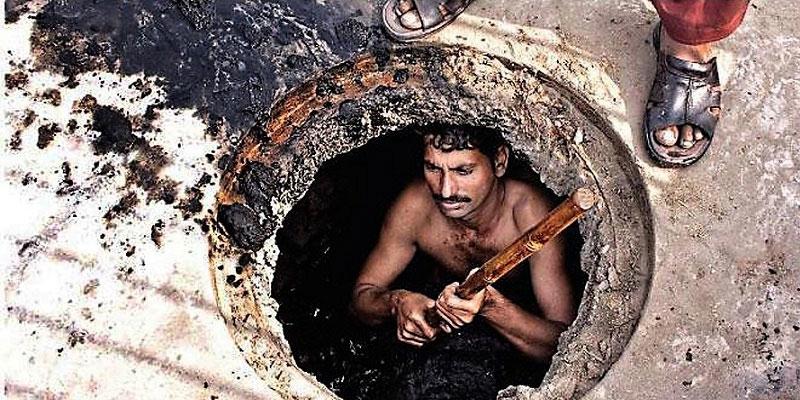
Cities in India are growing fast. New roads, metro systems, business districts, and high-rise apartment developments are altering the face of the urban landscape. But behind this image of modernisation is an older and more disturbing reality: that workers still enter sewers, septic tanks, and drainage chambers by hand, often without proper protective gear, breathing apparatus, or emergency rescue devices. As a consequence, needless deaths have become a recurrent phenomenon.
The Safai Karamchari Andolan (SKA) said 101 persons died in sewers and septic tanks in the first 188 days of 2026. The organisation registered 121 such deaths in 2025. The report said that about every 45 hours, a sanitation worker died in those conditions. The figures given by the government are much lower. The difference is more than a statistical difference. What happens when the work that caused a death is rendered invisible by the State’s definition? It raises a basic question:
A Ban That Hasn’t Stopped Dangerous Work
The Prohibition of Employment as Manual Scavengers and Their Rehabilitation Act, 2013, made manual scavenging an offense in India. But the ongoing death of workers in sewage infrastructure shows the gap between prohibition and practice. One part of the problem is the terminology. For example, a worker who dies in toxic gasses while entering a sewage or septic tank may be classified as having died during 'hazardous cleaning' rather than being a victim of manual scavenging. The difference may be administratively convenient, but it does little to change the facts on the ground.
The National Commission for Safai Karamcharis has a database of deaths in sewage and septic tanks till 2026. The government told Parliament in 2022 that 347 people died over five years while cleaning sewers and septic tanks. Uttar Pradesh, Tamil Nadu, and Delhi accounted for about 40% of these deaths. So, it’s not just a few bad contractors or unfortunate events that are the problem. Governance of sanitation has failed at the systemic level.
The City Above is in Debt to the Worker Below
Modern cities rely on sanitation workers. Sewage networks remove human waste from millions of homes, hospitals, workplaces, industries, and commercial facilities daily. Septic tanks need to be emptied. We need to fix sewer lines. Roads have to be cleared. But the infrastructure of urban living is often invisible to the people who use it. Only when something is wrong do we see the sanitation worker. A worker goes down into a manhole. He blacks out. Worker killed trying to save another. Sometimes a third person comes in. A regular cleaning job can easily become a chain of such deaths.
But sewage isn’t the only risk. Toxic gases and low oxygen may be present in confined spaces. It can be fatal to enter such places without adequate gas detection, ventilation, breathing equipment, harnesses, and skilled rescue crews. That is why the State’s role does not end with the distribution of gloves or the announcement of compensation after a death. The main question should have been far simpler: why did a human being have to enter the sewage in the first place.
Technology is Real Thing. There’s no Political Will Yet.
India lacks no technology to mechanise sanitation. In 2023, the Union government announced the National Action for Mechanised Sanitation Ecosystem (NAMASTE) with the stated goal of reducing hazardous cleaning and eliminating deaths in sanitation work. The programme includes profiling of sanitation workers, occupational safety training, personal protective equipment, health insurance, capital incentives for sanitation equipment, and the strengthening of Emergency Response Sanitation Units. Its aim, as stated, is to ensure that cleaning operations are done using safety devices and by trained personnel. The problem is thus acknowledged in the government's own policy texts. The contradiction is that manual entry and policy machinery can coexist.
This is symptomatic of a deeper institutional failure. Mechanisation does not mean simply purchasing machines. Cities need functional equipment, trained operators, money for equipment maintenance, systems for emergency response, and strict procedures that ensure humans only go in as a last resort. Most importantly, contractors should not be allowed to treat their employees as disposable labour.
Outsourcing Can’t be Used to Delegate Responsibility
Much of the work of urban sanitation is done by contractors. This creates a chain of accountability, where towns can claim that sanitation workers are hired by private organisations, and contractors can point to inadequate municipal facilities or tight deadlines. But sewerage is a public service. Outsourcing does not absolve the duty to protect those who deliver that service.
This dilemma is illustrated by a recent incident. In 2026, the Calcutta High Court held the Kolkata Municipal Corporation responsible for the death of four workers in a sewer project in 2021. The court has directed to pay each worker ₹30 lakh. The court further said that the local body could not get away from its duty by outsourcing the work to a contractor.
That principle must be the rule, not the exception. When a municipality contracts out sewer cleaning, it must retain legal and administrative responsibility for the safety of all workers engaged in the work.
Caste Debate is Unavoidable
The plight of the sewage workers is closely linked to the history of caste-based employment in India. The work of sanitation has long been imposed on communities who face discrimination on the basis of caste. The hazards of urban cleanliness are not evenly distributed because sanitation labor continues to be disproportionately performed by marginalised groups. Everyone makes shit. No one, however, goes down into the sewer. That is something important to differentiate.
When poverty, social exclusion, and a very unequal labour market mean that a worker has to go down a dangerous sewer without proper protection, then talking about the fatal outcome as an "accident" removes it from its structural context. It also conceals the question of dignity. The constitution guarantees equality and the right to life and dignity. But the persistence of putting humans in situations that can kill them in minutes is a profound failure to translate rights like these into working conditions.
Compensation Must Not be the Price of Life
The legal framework around sewage deaths was tightened by the Supreme Court in 2023, with compensation for families of workers who die while cleaning sewers or septic tanks being increased to ₹30 lakh. Yet, compensation is not prevention. Losing the main breadwinner doesn’t guarantee safety at the workplace even after getting ₹30 lakh.
The National Commission for Safai Karamcharis keeps a record of compensation payments in cases of sewage and septic tank mortality. The fact is that compensation remains an administrative issue that needs to be monitored. We should not be looking to improve compensation when people are still dying.
From Swachh Bharat to Worker Safety
India has made huge investments in sanitation infrastructure and awareness campaigns for cleanliness. But a really clean city cannot be built over the deaths of the people that keep it clean. The success of sanitation policies cannot be determined by the number of toilets built, waste collected, or kilometers of sewerage laid. The test is whether the worker who keeps the infrastructure running gets home alive.
The current NAMASTE framework explicitly calls for “zero fatalities” and a move to mechanised sanitation. A government paper from 2026 also calls for a "manhole-to-machine-hole ecosystem” transition and outlines measures, including Emergency Response Sanitation Units, safety equipment, occupational training, and worker profiling. The challenge now is to get it done.
Each metropolitan municipal government should maintain an inventory of sewer infrastructure, mechanised cleaning teams, gas detection equipment, emergency rescue capacity, and publicly available records of hazardous-cleaning operations. Contractors who ignore safety laws should be held criminally and financially accountable. The investigation should begin with who gave permission to enter and why mechanisation was not used when a worker dies, instead of writing off the worker’s death as a tragic occupational hazard. Finally, India’s sewage crisis is not a sewage disaster. It’s a “value crisis."
The country has demonstrated its ability to construct complex infrastructure, embrace digital governance systems, and invest in advanced technologies. The question is whether it is prepared to provide that technological and institutional capacity to workers whose labour is essential, but whose lives are routinely written off as expendable. The sewer is never to be regarded as a place of work where death may occur. A city cannot be called clean if the people who clean the city are dying underground.
The writer is a columnist and climate researcher with experience in political research analysis, ESG research, and energy policy. The views are personal.
Get the latest reports & analysis with people's perspective on Protests, movements & deep analytical videos, discussions of the current affairs in your Telegram app. Subscribe to NewsClick's Telegram channel & get Real-Time updates on stories, as they get published on our website.