





Destruction Vs Protection: The Politics of Letting People Die
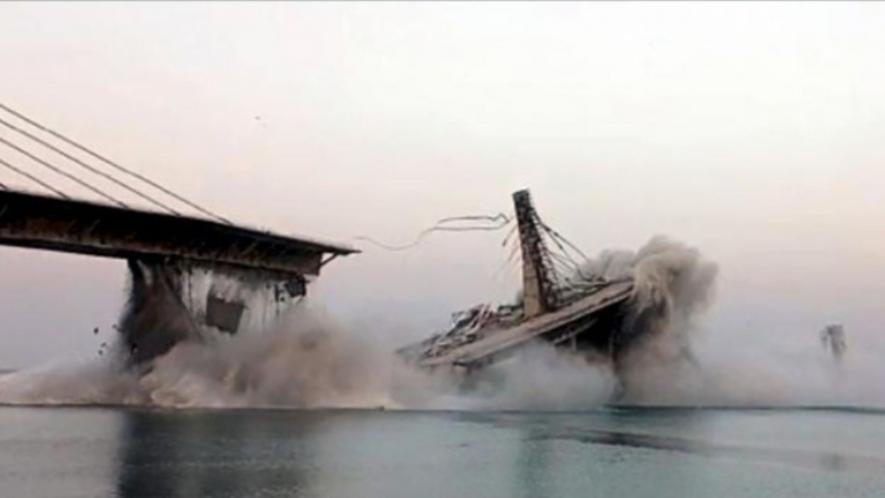
Image Courtesy: Twitter
Last week, Delhi witnessed two fatal incidents. In Gurmandi, a bridge collapsed. In Palam, a fire trapped a family in their home. The former claimed one life- at least officially, while the latter claimed nine, all from same family. Both were preventable.
The Gurmandi bridge was known to be unsafe for over a year. The rational response was to dismantle it and construct a new one. Instead, the authorities simply barricaded one side but left enough space for people to slip through. The bridge cut a 2km detour so locals, including children, continued to use it.
In Palam, the fire brigade wasn’t equipped with a safety net, and the hydraulic ladder was neither deployed in time nor tall enough to reach the blazing third floor, where the family waited to be saved.
These two incidents, despite being different in nature of causes, have one thing in common-- at the moment of crisis, when people needed to be rescued, the State failed. More important, these are not anomalies, but latest entries in the log of preventable deaths in India due to the State’s failure—be it caused by contaminated water, air pollution, pothole accidents, manual scavenging, sewer & septic tanks, bridge & building collapses, hospital fires, stampedes, etc.,. The pattern doesn’t change. Only the location and number of casualties do.
That the State fails is obvious. But failure is quite a simple word, as it suggests a lapse that can be corrected. What happened in Gurmandi and Palam was predictable outcomes of a system designed to prioritise something other than protection of life. The State which leaves the bridge unattended maintains its bulldozers perfectly. The State whose fire truck doesn’t deploy ladders on time, demolishes homes on schedule. The machinery of destruction is always in order, while that of protection is always broken. This is no coincidence. It’s designed to function exactly as it does.
The Betrayal of Social Contract
The relationship between the State and its citizens is often described as a social contract. Individuals consent to surrender certain freedom for their guaranteed protection. The State sets rules, maintains order and ensures safety. If it fails to uphold its end, people have the right to come out of this arrangement.
However, in the modern political system, this contract has become a trap since there is no way a person can ‘choose’ not to be part of the State when it fails. There is no exit option. The State has ensured that being a citizen is the only way an individual has a chance to survive. An individual cannot imagine her existence outside its machinery. In India, the contract is not an imaginary one. It is coded in Article 21 of Constitution, which mandates “Protection of life”, which is, one could argue, consistently being violated by state itself.
Procedural State
The gap between the constitutional ‘Right to Life’ and lived reality of being ‘Left to Die’ is not accidental. It is rooted in the structure of the Indian State, which was, similar to other post-colonial States, not born from revolution. It was simply inherited from the British colonial administration that designed it for two major purposes -- extraction of resources and control over population. Our bureaucracy was built to collect revenue, maintain colonial order and suppress dissent. It wasn’t designed to serve people, ensure their welfare and protect them.
This institutional design shapes how the system functions in practice. Scholars define India as a ‘Procedural State’. The job of the bureaucracy is to process files, not save lives. It prioritises following procedures over achieving outcomes. This results in a reactive nature of functioning rather than a proactive one.
The bridge collapsed because of this procedural logic-- it was reported damaged and the correct procedure was followed: restrict access but not enough to disrupt movement so that people don’t demand a new bridge. The State diffuses responsibility across departments so that when a bridge falls, accountability cannot be traced. The officers are not paid to fix problems but to simply follow all the processes.
This can be understood through the ‘principal-agent problem’: the agent – the bureaucracy acts on behalf of the principal -- the citizen, but pursues its own self-interest. The authorities knew the bridge was weak and fire equipment was faulty but reporting these problems would reflect poorly on their performance and require them to work extra. So, they did nothing.
Political Visibility
We encounter a puzzle here. Isn’t it glorious for the State to prevent and save lives? It would certainly be electorally rewarding, wouldn’t it? Then why doesn’t the State do more of it? The explanation lies in ‘Political Visibility’. A prevented disaster is invisible. It makes no headlines. A government may gain more votes by inaugurating a new bridge -- which is photogenic, and is etched in public memory through mass media-- than by ordering its maintenance.
There’s a high chance that relief packages handed out during floods generate more traction than handing out budget for flood control measures. The State is rewarded more for recovering than for preventing. It allocates resources where political return is the highest. The fire department arriving with a malfunctioning machine wasn’t some mechanical failure. It was a policy choice. The budget for maintenance was likely diverted and its inspections were likely forged since maintenance is politically invisible. This way, crores of money are saved by government and redirected to fuel populist initiatives such as ‘MLA on Wheels’.
Display of Power & Necropolitics
This brings us to another puzzle. Why does the machine that destroys always works while the machine that saves always break? The answer can be traced to the concept of sovereignty. The State’s machinery of destruction is its display of sovereignty. Its display of power. The bulldozer works because the State needs it to work. It caters to their jingoist vote bank -- the performance of being in control, of being able to act. The State maintains its capability of violence while neglecting its capacity to help.
Political theorist Achille Mbembe describes this as Necropolitics: political power operating through deciding who lives and who dies. The State expresses its power not by making people live but through letting them die. Necropolitics isn’t about direct killing. It’s about the capacity of the State to create conditions where certain populations are pushed to death routinely. The bridge that was left to fall and the fire truck that couldn’t reach to third floor were necropolitical events. No one actively killed these people but the State created circumstances where death was inevitable.
Who Does the State Let die?
This raises an uncomfortable question. If the State operates through letting people die, then which people does it let die? Political scientist Partha Chatterjee offers an answer. He distinguishes ‘civil society’ from ‘political society’. Civil society consists of citizens with rights, legal standings and ability to make demands. These are people who matter. Political society, on the other hand, consists of populations that are merely governed, managed, always bargained with and ignored.
In India, civil society is the domain of the elite, while political society is the domain of the rest. The victims in Gurmandi belonged to the political society. They were not citizens with effective rights. Their safety was a favour on them, not their right. This is not stated in any government manual. It is embedded in the functioning of the State.
Consider the Gurmandi bridge itself. It connected Gurmandi to Roop Nagar. Roop Nagar is affluent. Gurmandi is not. There were concerns among residents of Roop Nagar that the bridge made theft easier. But a complete closure would have disrupted the flow of domestic workers who traveled from Gurmandi to Roop Nagar every day. So, the State arrived at a compromise. The bridge was barricaded, but space was left for pedestrians to slip through. Enough space to cross on foot but not on vehicle. Workers were given space enough to reach work and return home, but not enough to be protected, since they’re part of political society.
There lies a paradox here. Roop Nagar residents view Gurmandi with suspicion but they depend on their services. The bridge was necessary not for mobility but for labour supply from Gurmandi to Roop Nagar. The barricading that allowed pedestrian and not vehicle shows us that the presence of people of Gurmandi were tolerated as labour force and not as right-bearing citizens. The children now need to walk 4km extra daily and in the longer run, it would determine who would get education and who would not.
Inquiry Commission as Shock Absorber
The State has also engineered a significant mechanism in the form of an Inquiry Commission to ensure the pattern continues without backlash. It absorbs outrage without requiring action. It has become a substitute for accountability. The State justifies that they need inquiry to find out who’s guilty, and since inquiry takes time, they appeal public to have patience.
Political scientist Murray Edelman wrote about ‘Symbolic uses of Politics’. He argued that much of what the State does is symbolic, designed to manage public perception rather than solve problems. The inquiry commission is a perfect example. It appears as action but functions as delay.
Why does it work? Why do we accept it?
Part of the answer to this lies in the structure of media. Among many things for which the State doesn’t need to worry about, the media’s 24hr news cycle -- now even shorter with social media -- remains at top. It ensures no tragedy occupies our attention for long. Over time, this produces the ‘Routinisation of Tragedy’. The unacceptable tragic deaths are normalised, the backlash is temporary and that’s why the State doesn’t fear it.
Population have become masses and death of people is counted as numbers. The State doesn’t care because it doesn’t have to. The victims belong to political society. An inquiry commission will be announced. Compensation will be provided. The machinery will move on. And most of us will feel gratitude: I am glad it was not me. This gratitude is State’s greatest ally. It turns potential outrage into silence. It seals the fate of those who will die in next tragedy.
The writer is a student at Dept of Political Science, University of Delhi. The views are personal.
Get the latest reports & analysis with people's perspective on Protests, movements & deep analytical videos, discussions of the current affairs in your Telegram app. Subscribe to NewsClick's Telegram channel & get Real-Time updates on stories, as they get published on our website.