





The Battle for a Multipolar World

Image Courtesy: Pexels
The contemporary international system is undergoing a decisive structural rupture, signalling the historical exhaustion of American unipolar dominance. For much of the post–Second World War era, US hegemony was sustained by a mutually reinforcing triad: the global primacy of the dollar anchored in the petrodollar regime, an expansive and permanent military infrastructure, and institutional command over international finance. This configuration appeared, for decades, to be a permanent feature of global capitalism. That illusion has now collapsed.
The capacity of the unipolar order to manage its own contradictions has eroded under the cumulative weight of sanctions warfare, technological fragmentation, and the chronic displacement of crisis onto the periphery. What confronts the world today is not a cyclical correction within the existing system, but a qualitative transformation in the organisation of global power.
Counter-Hegemonic Consolidation in Global South
As Western authority weakens, an alternative pole of accumulation and coordination has begun to consolidate across the Global South, most visibly through formations such as BRICS and the Shanghai Cooperation Organisation. This realignment represents far more than expanded South–South cooperation. It marks the emergence of an incipient counter-hegemonic bloc seeking to reorganise the global political economy beyond Western control.
By the mid-2020s, de-dollarisation has moved from aspiration to material practice. Local-currency settlements, gold-linked mechanisms, and alternative payment infrastructures have progressively reduced exposure to Western coercive instruments. The dollar’s so-called “exorbitant privilege”—long identified in Marxist theory as a mechanism of surplus extraction through finance rather than production—now confronts structural limits imposed by material resistance from productive and resource-holding economies.
From Economic Coercion to Open Militarism
As financial leverage declines, imperial power has increasingly substituted economic discipline with direct force. The January 2026 US military intervention in Venezuela, culminating in the seizure of President Nicolás Maduro, illustrates this transition from mediated domination to overt coercion. Publicly framed as a counter-narcotics operation, the intervention’s strategic content was revealed through the rapid reintegration of Venezuelan oil into US energy circuits. This episode functions as a laboratory of late-stage imperial behaviour. Sanctions, once central to the architecture of control, have lost effectiveness against states embedded within alternative economic networks. Kinetic intervention has, therefore, emerged as a compensatory mechanism for declining structural power.
Iran and the Logic of Permanent War
If Venezuela exposes the return of open interventionism, Iran reveals its systemic implications. The escalating military posture directed at Tehran—coordinated through US–Israeli strategic alignment—signals a decisive shift from containment to confrontation. Iran is no longer treated as a regional actor to be managed, but as a structural obstacle to imperial command over Eurasian energy corridors, trade routes, and security architectures.
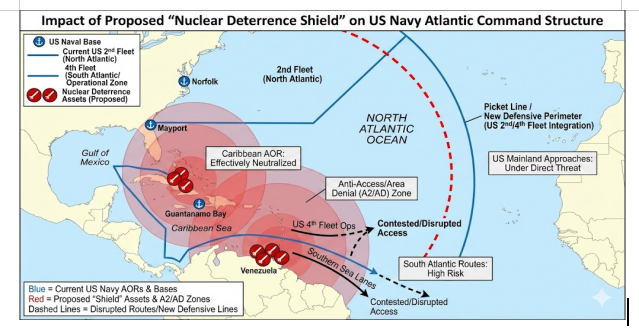
The mobilisation of naval forces in the Persian Gulf and the adoption of pre-emptive strike doctrines against Iran’s nuclear infrastructure reflect a broader strategy of permanent militarisation. This posture directly intersects with the deterrence framework advanced by Russia and China, which seeks to establish exclusion zones through missile-defence integration and strategic parity.
For Iran, the conflict transcends immediate state security. It is framed as a struggle for civilisational survival, shaped by the catastrophic precedents of Gaza and the wider Levant. The regional consequences of this confrontation extend far beyond Tehran, threatening to entrench a permanent war economy across West Asia.
Sovereignty, Deterrence, and Structural Resistance
Iran’s nuclear programme must, therefore, be situated within a broader historical logic. The issue is not proliferation, but sovereignty. Peripheral and semi-peripheral states that pursue industrialisation, energy independence, or deterrent capacity inevitably confront imperial resistance. Technological development becomes politicised precisely because it undermines hierarchical dependency.
Across Palestine, Syria, Yemen, Iraq, and Lebanon, the consequences of imperial militarism are already visible. These societies bear the scars of proxy warfare, collective punishment, and intervention insulated from accountability by geopolitical privilege. Gaza, in particular, has become a stark illustration of how imperial power operates through regional intermediaries while evading international censure.
Financial Imperialism and Energy Reconfiguration
Parallel to military escalation, global energy markets are undergoing a destabilising realignment. Heightened geopolitical risk has injected persistent volatility into pricing structures, while coordination among hydrocarbon-rich states in the Global South increasingly challenges Western-dominated frameworks.
The convergence of energy sovereignty and monetary diversification strikes at the core of financial imperialism. Dollar-denominated energy trade is progressively displaced by multi-currency and gold-linked systems, weakening the rentier foundations of US power. This process represents a form of class struggle at the level of the world system, opposing productive and resource-holding economies to a financial order dependent on crisis externalisation.
Militarisation of Trade Routes and Strategic Geography
As economic instruments lose efficacy, control over material circulation has become decisive. Maritime chokepoints, undersea infrastructure, and alternative trade corridors now function as primary theatres of contestation. Efforts to bypass Western-monitored routes reflect a broader attempt to reorganise global commerce beyond imperial supervision.
Joint naval exercises, defence coordination, and logistical integration within emerging multipolar formations signal the crystallisation of a collective security logic rooted in deterrence rather than accommodation. The expansion of rivalry—from West Asia to the Arctic, from the Indian Ocean to the Atlantic—reveals a system struggling to contain its own displacement.
Toward a New World Order
The rejection of US President Donald Trump’s proposed “peace board” initiative by both China and Russia has underscored the widening strategic rift within the international system. Rather than serving as a platform for de-escalation, the proposal was interpreted in Beijing and Moscow as an attempt to reassert unilateral authority under the guise of conflict management. In response, Chinese officials have issued unusually explicit warnings, stating that while they would not initiate hostilities, any large-scale military assault by the US and Israel against Iran or Venezuela would be met with overwhelming retaliation. These declarations mark a departure from strategic ambiguity toward a doctrine of deterrence through certainty.
Simultaneously, the Persian Gulf has entered a phase of acute militarisation. Following sustained internal unrest in Iran during early 2026, the US administration has redeployed a substantial naval formation toward the region, reportedly led by the USS Abraham Lincoln. The justificatory narrative has shifted decisively—from rhetoric centred on human rights to an overtly pre-emptive posture aimed at Iran’s nuclear and strategic infrastructure.
This escalation directly challenges the deterrence architecture advanced by Russia and China. Through the deployment of advanced missile-defence systems and the pursuit of strategic parity among allied states, Moscow and Beijing seek to construct exclusionary security zones designed to constrain US naval freedom of manoeuvre. For Iran, the confrontation is not reducible to regional power politics; it is articulated as a struggle for civilisational survival, shaped by the devastation witnessed in Gaza and across the wider Levant.
The convergence of these military dynamics has reverberated through global energy markets. Heightened geopolitical risk has introduced a pronounced shock premium, driving Brent crude prices sharply upward by late January 2026 despite earlier projections of oversupply. This volatility is being leveraged by emerging Global South coalitions to accelerate a transition toward multipolar economic arrangements.
Two structural shifts are particularly significant. First, trade flows are being reoriented through alternative maritime corridors, including the Eastern Maritime Corridor linking South Asia with the Russian Far East and the Northern Sea Route, thereby reducing dependence on Western-monitored chokepoints.
Second, monetary realignment has intensified. In response to US tariffs and secondary sanctions on states engaging with Iran, several energy producers have expanded the use of gold-linked and multi-currency settlement systems, steadily weakening the centrality of dollar-denominated trade.
These developments confirm that the unipolar order is not receding through negotiated adjustment, but through sustained confrontation. Venezuela and Iran function as structural fault lines rather than isolated crises, exposing the limits of coercive governance in a transforming world system. Decisions taken in these theatres will shape future alliance patterns and determine the material conditions of sovereignty, development, and security for vast populations.
Multipolarity, while offering expanded policy space for the Global South, unfolds within a capitalist order marked by uneven development and a persistent tendency toward militarised rivalry. Whether this transition stabilises into a more balanced international configuration or descends into systemic violence will depend on the interaction between popular pressures, state strategies, and imperial resistance.
What is now beyond dispute is that the era of uncontested unilateral dominance has reached its historical boundary. The redistribution of power is underway, driven by demands for strategic parity and control over material resources. As the US increasingly relies on direct force to secure energy frontiers, the coordinated roles of China, Russia, and India assume heightened significance in shaping an emergent order—one premised on claims of equal and indivisible security and the gradual dismantling of imperial subordination.
Roadmap of Global South Leadership, Strategic Protection
1. Material Capacity for Leadership
By the mid-2020s, China, Russia, and India have accumulated sufficient economic scale, technological depth, military deterrence, and diplomatic reach to function as coordinating anchors of the Global South. Their combined capacities enable agenda-setting beyond Western institutional dominance.
2. BRICS as a Collective Security Forum
The BRICS bloc is increasingly discussed not only as an economic platform but as a political mechanism for shielding member states from coercive regime-change pressures, sanctions warfare, and external military threats.
3. Deterrence Discourse
Within strategic debates, some analysts argue that credible deterrence parity—rather than unilateral vulnerability—is viewed as a prerequisite for sovereignty. In this discourse, states such as Venezuela, Cuba, Brazil, South Africa, Iran, and Nigeria are cited as geopolitically exposed nodes whose security deficits invite external intervention.
This remains a theoretical deterrence argument, not a declaration of intent or consensus policy.
4. Strategic Objective
The stated aim of such deterrence debates is the prevention of war, not escalation:
- discouraging first-strike doctrines,
- limiting naval and aerial coercion,
- and reducing the incentive for external militarised intervention.
5. Global South Stabilisation Logic
Advocates of this framework claim that when power asymmetries narrow, diplomatic negotiation replaces force. In this view, sovereignty, development autonomy, and political pluralism become more viable once existential threats are neutralised.
6. Structural Endgame
The broader goal articulated in these discussions is a post-unipolar security order—one where no single power can impose outcomes through overwhelming force, and where peace is maintained through mutual vulnerability rather than unilateral dominance.
This roadmap reflects strategic reasoning circulating in multipolar transition debates, not an endorsement of proliferation or conflict. It highlights how deterrence, leadership capacity, and collective security are being theorised as tools to avoid war, preserve sovereignty, and stabilise an increasingly fragmented international system.
The writer, an economics professor and author, is currently engaged in research on Sustainable Economic Development, Political Economy of the Global South, and India’s Socioeconomic Crisis. The views are personal. acpuum@gmail.com.
Get the latest reports & analysis with people's perspective on Protests, movements & deep analytical videos, discussions of the current affairs in your Telegram app. Subscribe to NewsClick's Telegram channel & get Real-Time updates on stories, as they get published on our website.